Software for travel and visa offices in Egypt: tracking Schengen, Gulf visa and work-contract files from document intake to passport handover
A travel and visa office in Egypt needs one file per customer and per application, holding the service (Schengen, a Gulf visit visa, a work contract, a travel booking), the required documents and which have arrived, the current stage from “awaiting documents” to “ready for collection”, and the official fees, office fee and balance. Because embassy requirements, fees and timelines change, document checklists should be reviewed regularly against official sources, not saved once and forgotten.
Last updated:
What travel and visa offices in Egypt do every day
A travel and visa office in Egypt combines several kinds of work: preparing Schengen visa files for tourism, family visits or business, Gulf visit visas, and the procedures for people who have landed a job contract in a Gulf country, alongside flight, hotel and tour bookings. Each service has its own documents, authority and expected timeline.
As files pile up, the familiar problems appear: a file stalled because a bank statement is missing and the customer wasn't told, a customer calling every day about their passport with no one able to answer on the spot, a balance nobody remembered to collect, or an enquiry from a Facebook ad that no one followed up so the customer went to another office. Each one costs time, money or trust.
This guide suggests an organised way to manage your office's files. If you're comparing customer management software in the Egyptian market in general, see the guide to the best CRM in Egypt or RabetCRM in Egypt.
File types and what to track for each
The table below is a general summary for organising work inside the office, not an official list of requirements. Each embassy's requirements, fees, processing times and appointments change from time to time and differ by country and visa type, so always confirm on the official website of the embassy or its appointed visa application centre, such as VFS Global or another provider depending on the country.
| File type | Authority | What the office tracks |
|---|---|---|
| Schengen visa | The destination country's embassy or its appointed application centre | Appointment, complete documents, biometrics, passport return |
| Gulf visit visa | The official authority in the destination country | Visa type, duration and travel date |
| Gulf work contract | The employer and the competent authorities in Egypt and the host country | Documents, attestations, medical exam and approval stages |
| Document attestation and translation | The competent attestation authorities | Originals received and handover date |
| Flight and hotel bookings | Airlines and hotels | Travel date, paid and balance |
Schengen files: the document checklist comes first
What most often delays or weakens a Schengen file is a missing or non-compliant document. The practical fix is to define the document list for each file type once, so it appears on every new file and you tick each document as it arrives. Any employee can then see at a glance what each customer is missing and send one clear request instead of repeated messages.
The documents below recur in many tourist visa files, but this is not an official list for any embassy: each embassy sets and may change its own requirements, so check its official website or the application centre's site before preparing each file, and update your checklists accordingly.
- A valid passport with the validity the embassy requires
- Photos meeting the required specifications
- A recent bank statement
- A letter from the employer or business documents
- Flight and accommodation bookings or a travel plan
- Travel medical insurance as the embassy requires
Gulf work contracts: a long file with successive stages
The file of someone with a job contract in Saudi Arabia, the UAE, Kuwait, Qatar or elsewhere is longer than a tourist visa file, because it's a chain of steps that may include attesting certificates and documents, a medical exam, completing the employer's procedures, then visa issuance and travel. These steps and their requirements differ by country and profession and change over time, so confirm the current path with the official authorities in Egypt and the host country before promising the customer any date.
The best way to manage this kind of file is to split each step into a clear stage on the customer's file, so you always see what's done, what's pending and who it's waiting on: the customer, the employer or the authority. If the customer will hold a residency in a Gulf country, record its expiry after they travel; that opens a door to serve them at renewal or when their family travels.
File stages, fees and balances
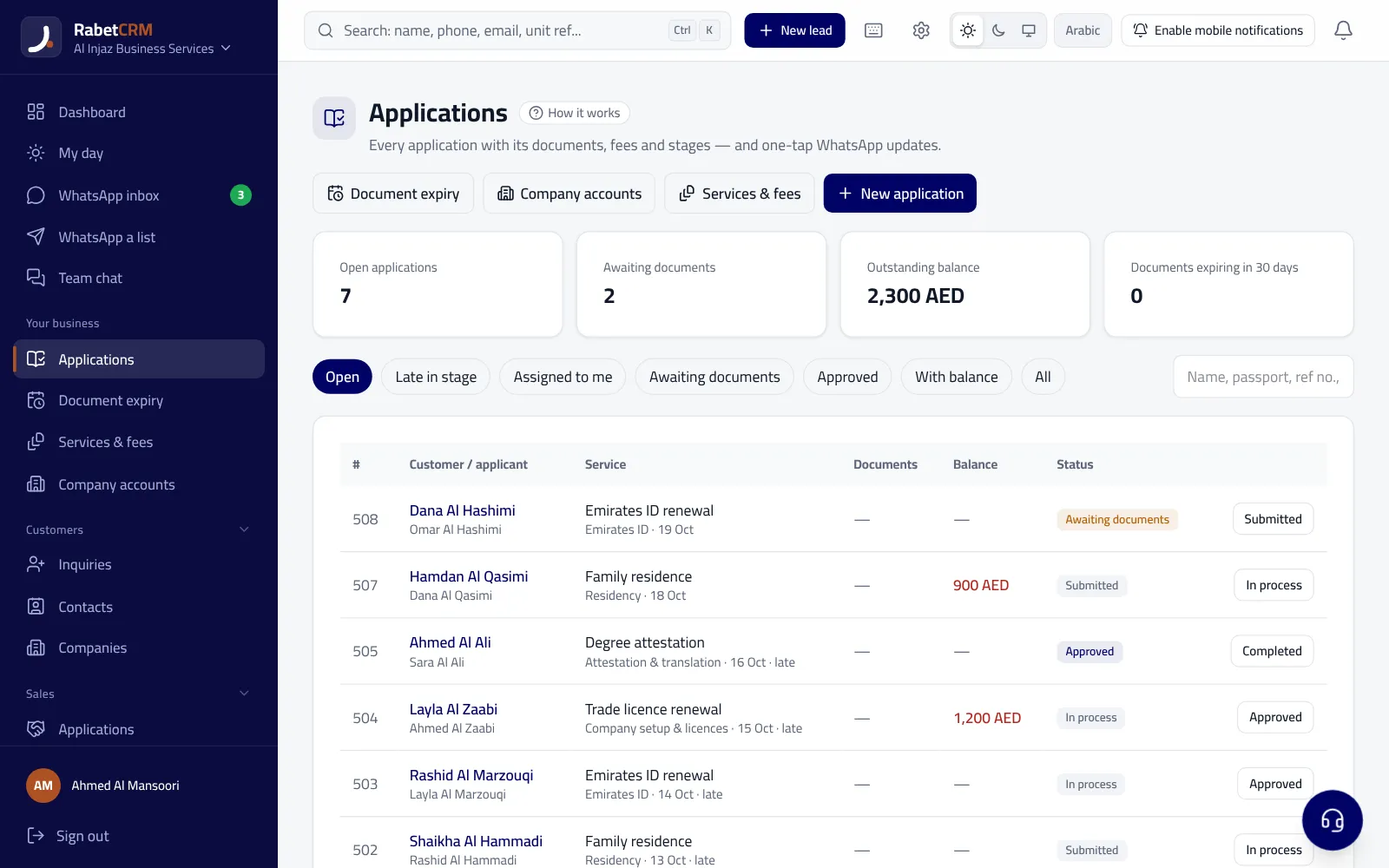
A clear stage is what makes answering customers fast. Agree fixed stages for every file in the office, and tie each stage to a ready customer message: “missing documents” naming what's missing, then “submitted”, then “ready for collection”. A customer who hears from you before asking feels reassured, and the calls that interrupt staff drop.
Always keep the official fees the office pays on the customer's behalf (embassy or application centre fees, for example) separate from your service fee, then the amount paid upfront and the balance. We don't publish official fee figures here because they change and vary by country and visa type. Illustrative example of the recording method only: an official fee in EGP, a separate office fee and a down payment, so the balance appears automatically.
- Awaiting documents: open, with specific documents missing
- Ready to submit: documents complete, awaiting the appointment
- Submitted: application filed and its reference recorded
- Processing: awaiting the authority's decision
- Ready for collection: customer informed, balance collected
Passports and customer data: a legal responsibility
A visa office holds customers' passport copies, bank statements and employment details, some of the most sensitive personal data there is. Handling personal data in Egypt falls under Personal Data Protection Law No. 151 of 2020. So don't leave these documents in open WhatsApp groups or on employees' personal phones, and limit access to what each employee needs.
RabetCRM has role-based team permissions, so each employee can see only their own files while the manager sees everyone, and the customer's file and chats stay in the system if an employee leaves, instead of walking out on their phone.
How RabetCRM helps a travel and visa office in Egypt
RabetCRM for visa and transaction offices is built for this kind of work. You start from a ready list of services, then edit fees and documents or add your own, such as a Schengen visa for a specific country or a work-contract file. When you open a new file you pick the service and its required documents and fees fill in automatically, and you tick each document as it arrives. Every file has its stage and reference, total, paid and balance with official fees kept apart from the office fee, and amounts in Egyptian pounds.
You send customers one-tap WhatsApp messages in their name: “missing documents”, “approved” and “ready for collection”. You can connect the office's WhatsApp number to a shared team inbox in the system, so no enquiry from an ad or a referral gets lost. And you record residency expiry dates for customers working in the Gulf, so the system reminds you 60, 30 and 7 days ahead with a renewal message for the customer. It runs in Arabic and English, with prices in EGP when you choose Egypt on the pricing page. Start a 15-day free trial with no card.
More articles
FAQ
What is the best software for a travel and visa office in Egypt?
The best one opens a file per customer with the service, the document checklist and what's arrived, the current stage, official and office fees and the balance, plus ready WhatsApp messages for the customer. RabetCRM brings that together in Arabic and EGP with a 15-day free trial.
Which documents are required for a Schengen visa from Egypt?
Requirements differ by country and visa type and change over time, so check the official website of the embassy or its appointed application centre before preparing each file. The items in this guide are only common examples for organising your work.
How long does a Schengen visa take and what does it cost?
Timelines and fees are set by each embassy and application centre and they change, so don't rely on old published figures. Confirm them with the official source, tell the customer in writing and record them on their file.
How do I protect passport copies and customer data in the office?
Keep them in one system with permissions by each employee's role instead of WhatsApp groups and personal phones, and comply with Egypt's Personal Data Protection Law No. 151 of 2020.
Can I adapt services and documents to my office?
Yes. You start from a ready list of services and edit fees and documents or add your own, such as Schengen files for specific countries or work-contract files.