Laundry and dry cleaning software in Egypt: organising home pickup and delivery, pricing clothes and carpets, driver cash and packages for regular customers
A laundry or dry cleaner in Egypt needs one record per order showing the item count or carpet area, the price in Egyptian pounds, the assigned driver, the current stage from pickup to delivery, and the cash the driver collected. When that lives in one system instead of a notebook and scattered WhatsApp chats, disputes over missing items fall, the “where's my order?” calls stop, and the shop's day closes with matching numbers.
Last updated:
How laundries and dry cleaners work in Egypt
In Cairo, Giza, Alexandria and the new cities, many laundries and dry cleaners depend on customers from their neighbourhood and nearby buildings, and on home pickup, which customers now expect. A family in an apartment wants the driver to collect the laundry and carpets, a professional in a compound wants their shirt back ironed on time, and a company owner sends the office curtains for cleaning every so often.
The Egyptian market has clear seasons that multiply the pressure: the days before Eid, the change of season when families send carpets, blankets and duvets to be cleaned before storing them, and wedding and occasion seasons with more suits and dresses. Order volume jumps on those days, and if organisation depends on a notebook and the driver's memory, mistakes start: a forgotten pickup, a carpet nobody can match to its owner, or an angry customer whose order is late.
If you're looking for customer management software in Egypt in general, start with the guide to the best CRM in Egypt, or see RabetCRM in Egypt. This article focuses on the day-to-day work of the laundry itself.
Laundry order stages from pickup to delivery
The first step in organising any laundry is standardising the order stages, so every staff member knows their part and who moves the order on. With clear stages, anyone in the shop can answer a customer in seconds without calling the driver or searching through bags.
| Stage | What happens | What to record |
|---|---|---|
| Pickup request | The customer asks via WhatsApp, phone or the request page | Full address, time slot and service type |
| Driver assigned | The order goes to a driver by area | Driver name and expected time |
| Collected | The driver counts items or measures carpets with the customer | Item count, measurements and any existing damage |
| Cleaning | Washing, dry cleaning or ironing | Items needing special handling |
| Ready | Packed and matching the count | Count checked against pickup record |
| On the way, then delivered | The driver delivers and collects payment | Payment method and amount collected |
Counting and documenting items: ending “there was another shirt” disputes
Most disputes between a laundry and a customer start with an item the customer says was lost or damaged. The practical fix is documentation at pickup: the driver counts items in front of the customer, records them by type and service (shirts for wash and iron, a suit for dry cleaning, a dress, a carpet), and sends the customer a summary of what was collected. Any existing defect, like an old stain or a missing button, is noted, ideally with a phone photo.
For carpets, wall-to-wall rugs, kilims and curtains, length and width are measured and recorded at pickup so the customer isn't surprised by a different price on delivery. Inside the shop, tag each order's items with a numbered label or a separate bag, and check the count before packing and before the driver leaves; finding a shortfall in the shop is far easier than at the customer's door.
- Count items in front of the customer and record them by type and service
- Note existing stains and defects, ideally with a photo
- Measure carpets and curtains at pickup and share the estimated price
- Write delicate-item instructions on the order itself, not in the driver's memory
- Check the count before packing and before the driver leaves
Per-item and per-m² pricing in Egyptian pounds
A laundry offering several services deals with several pricing methods: clothes per item, priced by service (wash and iron, iron only, dry clean); carpets and curtains per square metre; sofas and living-room sets per seat; mattresses per piece. Worked out on a calculator, prices vary from one employee to the next and errors creep in, especially as prices change over time.
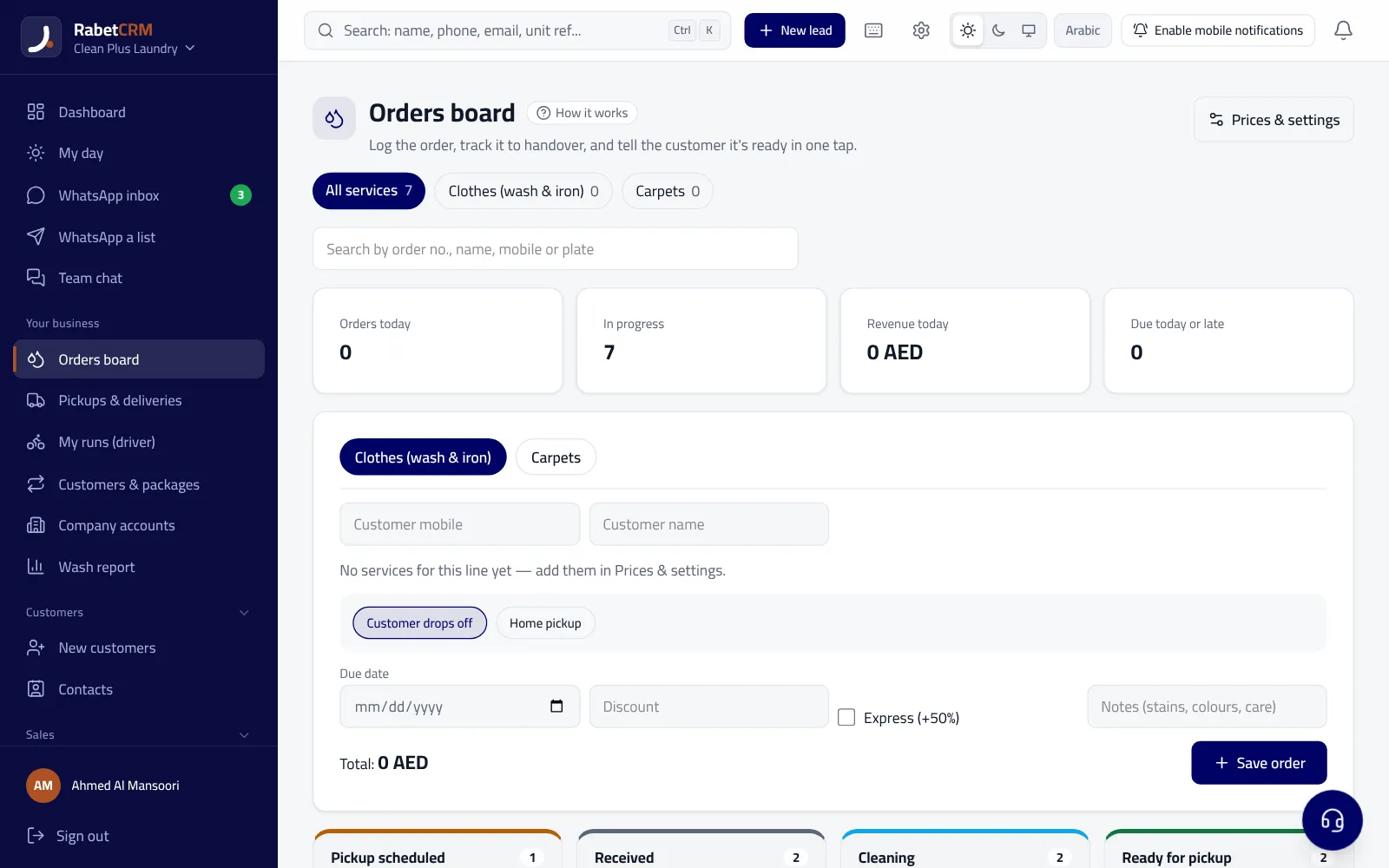
In RabetCRM's laundry software you set the price for each line in its own unit once, the order total is calculated automatically, a ticket prints for the customer, and amounts show in Egyptian pounds. Illustrative example only: if you set a per-square-metre carpet price in EGP and the driver measures a 6 m² carpet, the price appears instantly with no manual maths. Set your own prices based on your area and costs.
| Line | Pricing unit | Note |
|---|---|---|
| Clothes | Per item, per service | Wash and iron, iron only, dry clean |
| Carpets and rugs | Per m² | Measured at pickup |
| Curtains | Per m² | Record the number of panels too |
| Sofas and living-room sets | Per seat | Useful for in-home cleaning |
| Mattresses | Per piece | By size |
Drivers and home pickups: who does which run?
Most pickup and delivery complaints are about timing: a late driver, or a slot nobody remembered. Split the day into clear slots (morning and evening, for example), group orders by area or neighbourhood per driver to cut trips, and combine pickups and deliveries on the same run where you can: if a driver is delivering to a building, they can collect the neighbours' orders on the same trip.
In RabetCRM you assign a driver from your team to each order; they tap “On the way” then “Arrived”, and you see them on the map. Drivers don't need a special app: they open “My runs” in their phone browser and share their location, and can install it as an app. The customer receives a tracking link in the “on the way” WhatsApp message showing the order stage, the driver's location and a call button, so they're ready or can tell the doorman, and waiting time at each address drops.
WhatsApp and the online order page: take orders without losing them
In Egypt most customers ask for a pickup by WhatsApp message, and the problem is that these messages land on the owner's or an employee's phone, getting lost among personal chats or waiting until someone opens them. With RabetCRM's WhatsApp CRM, the laundry's number becomes a shared inbox inside the system that the team can see, and you can set permissions for each employee by role.
You can also publish an online pickup request page with your laundry's name, put the link on your Facebook page or Instagram bio, and customers request a home pickup there with the order reaching you instantly. Send customers short messages at the key moments: slot confirmation, then “driver on the way”, then a pickup summary with the item count, then “your order is ready”.
Driver cash, the daily close and packages for regulars
Most payment at Egyptian laundries is still cash on delivery, with some customers paying by transfer or keeping an account. When a driver collects all day, it's hard to know late at night what they should hand over. In RabetCRM you see the cash each driver holds, the supervisor taps “cash received” at handover, and a daily report shows cash, card and on-account, so the day closes with matching numbers.
Steady income comes from regulars: the family that sends laundry every week, the professional who has shirts ironed regularly, the company or clinic that has curtains and linens cleaned periodically. Offer them prepaid per-item packages and watch for anyone who misses their usual order. In RabetCRM you can set up per-item packages and send WhatsApp reminders to lapsed customers per line, so a carpet customer is reminded before the change of season on a different rhythm from a weekly clothes customer.
Customer data and how to get started
A laundry holds customers' names, numbers and home addresses, which is personal data whose handling in Egypt falls under Personal Data Protection Law No. 151 of 2020. So don't leave it in an open notebook or on employees' phones, and give each employee permissions that fit their role. RabetCRM has team permissions, and customers and their chats stay in the system if an employee leaves.
Don't change everything at once: start by standardising order stages and counting items at pickup, then add driver assignment and the tracking link, and after that switch on driver cash, the daily close and packages. RabetCRM for laundries runs in Arabic and English in the browser, with prices in EGP when you choose Egypt on the pricing page. Try it free for 15 days with no card. If you also run delivery for other businesses, read the guide to courier software in Egypt.
More articles
FAQ
What is the best software to run a laundry in Egypt?
The best one prices clothes per item and carpets per m² in EGP, organises pickup and delivery with driver tracking, sends customers a WhatsApp tracking link, and closes the day with each driver's cash. RabetCRM brings that together in Arabic with a 15-day free trial.
How should I price carpet cleaning?
Carpets are usually priced per square metre: length and width are measured at pickup and multiplied by your own per-m² price. In RabetCRM you set the price once and the total is calculated automatically.
Does the laundry driver need an app?
No. They open “My runs” in their phone browser and share their location, and can install it as an app if they like.
How do I know how much cash each driver holds at day end?
Record the amount collected at every delivery. In RabetCRM you see the cash each driver holds, the supervisor taps “cash received” at handover, and a daily report shows cash, card and on-account.
Can I offer packages or subscriptions to regular customers?
Yes. You can set up per-item packages for regulars and send WhatsApp reminders to anyone who misses their usual order, per line.