Tracking visa, residency, Emirates ID and company setup transactions: a practical guide for typing centres and PRO offices
To keep every transaction on track, a services office needs one record per application holding the service, the required documents and which ones have arrived, the current stage (awaiting documents, submitted, processing, approved, ready for collection), the government reference number, and the government fee, service fee and balance. Then it records the expiry date of each residency, Emirates ID and licence so it is reminded well ahead, and offers the renewal before the customer goes elsewhere or runs into fines.
Last updated:
Why do transactions slip in services offices?
A typing centre or business services office handles dozens of different transactions a day: a visit visa for a customer's relative, a family residency renewal, an Emirates ID replacement, a trade licence renewal, a certificate attestation and translation. Each has its own documents, government entity, expected duration and fees. At that volume, relying on memory, a notebook and scattered WhatsApp chats becomes a direct cause of mistakes.
The classic failures are familiar to every office owner: an application stuck for a week because a passport copy is missing and nobody told the customer; a customer calling for a status update that no one can answer on the spot; an outstanding balance that was never collected; or a long-time customer's residency expiring and being renewed at another office because you never reminded them. Each one costs time, money or a customer.
The core idea of this guide is simple: a services office doesn't earn only from the first application but from every renewal after it. Residencies, Emirates IDs and trade licences all renew, and a customer you served well once will come back if you remind them at the right time. That makes a tracking system not a luxury but the office's source of recurring revenue.
The government entities behind your transactions
Knowing which entity owns each transaction helps you estimate timing and prepare the right documents from the start. In the UAE, common individual and company transactions are spread across several federal and local entities. The table below is a general summary for guidance; details can differ by emirate and by type of establishment (mainland or free zone), so always confirm current procedures on each entity's official website.
At federal level, the Federal Authority for Identity, Citizenship, Customs and Port Security (ICP) handles residency, visas and the Emirates ID card in most emirates, and residency and Emirates ID can now be applied for together through a unified application on its smart channels. In Dubai, the General Directorate of Residency and Foreigners Affairs (GDRFA Dubai) handles residency and visa transactions, many of them submitted through approved Amer centres or the GDRFA app. Work permits for mainland company employees are issued by the Ministry of Human Resources and Emiratisation (MOHRE), processed through its digital channels or approved Tasheel centres. Free zone employees get their permits through the free zone authority.
| Transaction type | Most common entity | What the office should track |
|---|---|---|
| Residency and renewal | ICP, or GDRFA Dubai for Dubai residencies | Expiry date, medical test, health insurance, reference number |
| Emirates ID | ICP | Biometrics, card expiry, collection |
| Visit visas | ICP or GDRFA Dubai depending on the emirate | Visa duration, entry date, sponsor |
| Work permits (mainland) | MOHRE | Employment contract, offer letter, approval stages |
| Trade licences and company setup | The emirate's economic department or the free zone authority | Trade name, approvals, licence expiry |
| Attestation and translation | Ministry of Foreign Affairs and related bodies | Originals received, delivery date |
A ready document checklist for every service
The number-one cause of delay is a missing document. The practical fix is to define the document list for each service your office offers once, so it appears automatically on every new application and you tick each document as it arrives. Any staff member can then see at a glance what each customer is missing and send one clear request instead of repeated messages.
The documents below recur across many residency and ID applications, but this is not an official list: each service's requirements can change and differ by emirate and resident category, so review them regularly on ICP, GDRFA Dubai or MOHRE channels and update your checklists accordingly.
- A copy of a valid passport
- A recent personal photo meeting the required specs
- The current Emirates ID or residency for renewals
- Medical fitness result where the residency requires it
- Valid health insurance as the emirate requires
- A registered tenancy or proof of address for some family sponsorships
- Attested marriage or birth certificates for family sponsorship
- Trade licence and establishment card for company transactions
Transaction stages: from awaiting documents to completed
A clear stage is what makes answering customers fast. When every application moves through fixed stages agreed in the office, any staff member can answer a customer in seconds, and the manager can see where work piles up: is the bottleneck collecting documents, submitting, or waiting on the government entity?
It also helps to tie each stage to a ready customer message: "missing documents" naming what's missing, "submitted" with the government reference number, "approved", then "ready for collection". A customer who hears from you before asking feels reassured, and the calls that interrupt your staff drop.
- Awaiting documents: open, with specific documents missing
- Submitted: filed with the government entity, reference number recorded
- Processing: waiting on medical, biometrics or a decision
- Approved: approval issued, output being prepared
- Ready for collection: customer informed, balance collected
Government fees, service fees and balances
Mixing government fees with your own service fee is a common source of customer misunderstandings and weak office accounts. Better to record three separate figures on every application: the government fee you pay on the customer's behalf, your service fee, then the amount paid upfront and the balance. That shows your real margin per service and gives you a list of every application with an outstanding balance.
This guide doesn't publish government fee figures because they change and vary by service, emirate, residency duration and resident category. Keep a default price per service in your system, update it whenever fees change on the official channels, and override it on a single application when needed.
Residency, ID and licence expiry reminders: your recurring revenue
A resident's Emirates ID expires in step with their residency, and there is usually a grace period after a residency expires whose length varies by resident category, after which daily overstay fines apply. Because periods and fines can change, check each customer's exact situation with ICP or GDRFA Dubai — but the practical lesson holds: the earlier you start the renewal, the lower the risk for the customer.
A simple reminder plan works well: an alert 60 days before expiry to send the customer a renewal message and ask for documents, another at 30 days to chase anyone who hasn't replied, and a final one at 7 days. Apply the same to your corporate customers' trade licences. Most importantly, record each document's expiry date the moment the transaction completes rather than waiting for the customer to remember.
This list isn't only about renewals; it also shows the workload coming in the next months, so you can plan staff assignments ahead. A customer who gets a timely reminder from you feels your office looks after their affairs — and that's what makes them recommend you to relatives and colleagues.
Company setup and corporate PRO work
Company setup is longer and more complex than individual transactions because it's a chain of steps: choosing the activity and reserving the trade name, initial approvals, the memorandum and premises, licence issuance, then the establishment card and visas for partners and staff. These steps differ between mainland and free zones and from one emirate to another, so confirm the current path with the relevant emirate's economic department or the free zone authority.
The best way to manage it is to open an application for each step linked to the client company, so you see the whole company file: what's done, what's waiting, and what's been paid and is still due. Corporate clients are the most valuable over time, since every new hire means a visa, a work permit and an ID, and every year brings licence and residency renewals.
How RabetCRM helps you track transactions
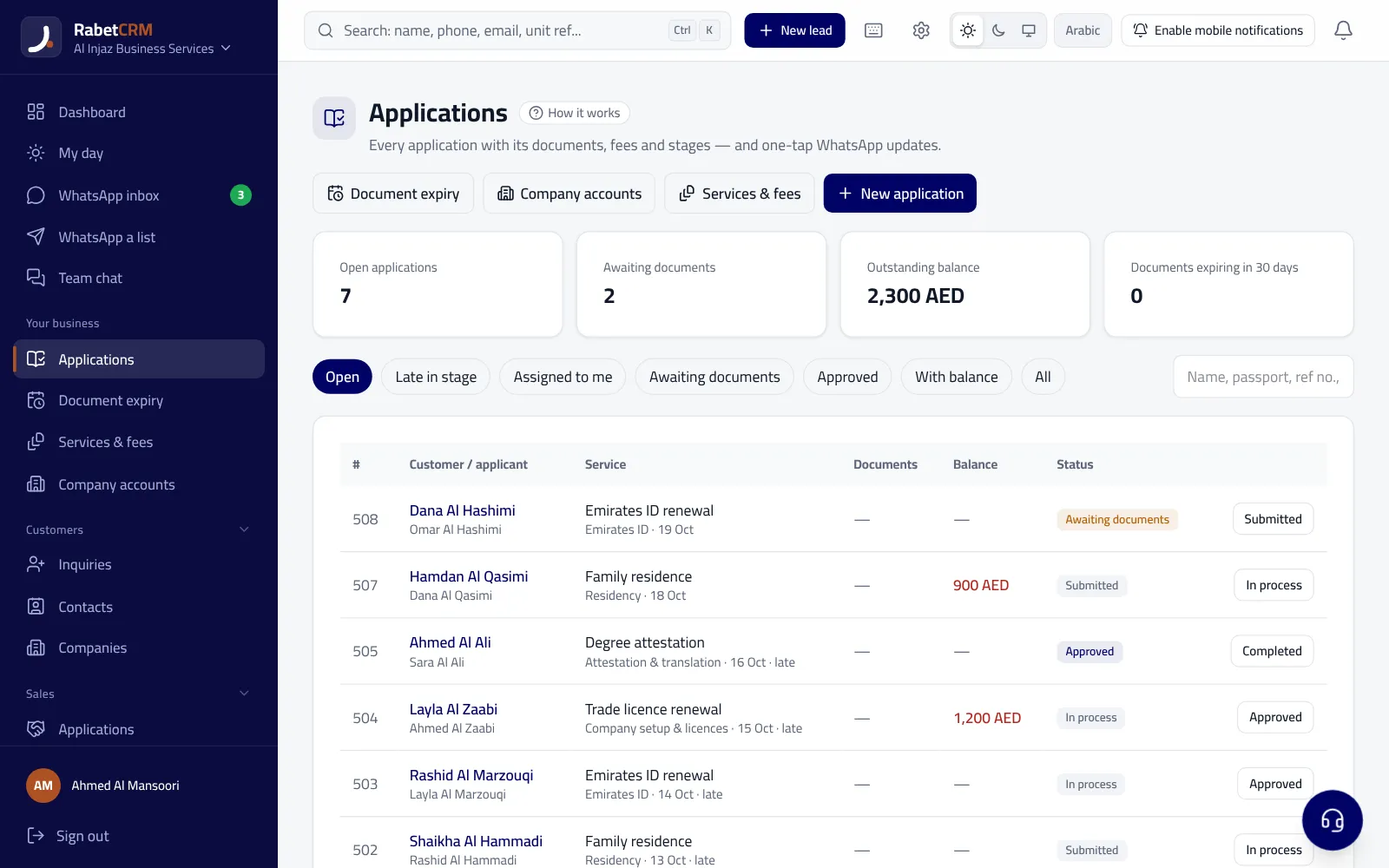
RabetCRM for business services and typing centres is built for exactly this work. You start from 14 common services (visit visas, family and golden residencies, Emirates ID, trade licences, attestation and translation), each with its document checklist, then edit fees and documents or add your own. When you open a new application you pick the service and its required documents and fees fill in automatically, and you tick each document as it arrives.
Every application has its stage and government reference number, total, paid and balance with government and service fees kept apart, and one-tap WhatsApp messages in the customer's name: "missing documents", "approved" and "ready for collection". You record when customers' residencies, IDs and licences expire and get reminded 60, 30 and 7 days ahead, with a renewal message for the customer and a button that opens the renewal application immediately. You can also connect the office's WhatsApp number to a shared team inbox. Explore RabetCRM for services offices or start a 15-day free trial with no card.
More articles
FAQ
What's the best way to track residency and visa applications in a services office?
One record per application with the service, the document checklist and what's been received, the current stage, the government reference number, fees and balance — plus a ready customer message at each stage and a reminder before the residency expires.
What's the difference between ICP and GDRFA Dubai?
ICP is the federal authority for residency, visas and the Emirates ID, while GDRFA Dubai handles residency and visa transactions in the emirate of Dubai, many of them through Amer centres. Confirm the competent entity for each transaction on the official websites.
When should I remind a customer to renew their residency?
Start about 60 days before expiry to leave time for documents, the medical test and insurance, then follow up at 30 and 7 days. Renewing early protects the customer from overstay fines after the grace period.
What's the difference between Amer and Tasheel centres?
Amer centres are approved by GDRFA Dubai for residency and visa transactions in Dubai, while Tasheel centres are approved by MOHRE for labour transactions such as work permits and employment contracts.
Is there Arabic software for typing centres and PRO offices?
Yes — RabetCRM has an Arabic and English interface, tracks applications with documents, stages and fees, and reminds you 60, 30 and 7 days before residencies and IDs expire, with a 15-day free trial.