Running a clothes, carpet and curtain laundry: organising pickup and delivery, tracking items and keeping customers informed
A laundry gets pickup and delivery right when every order has one record showing the item count or square metres, the price, the assigned driver and the current stage from pickup to handover. Customers stop calling to ask "where's my order?" once they receive a WhatsApp tracking link showing the order stage and the driver's location. And counting and documenting items at pickup remains the single most important step for avoiding disputes over a missing piece.
Last updated:
Why pickup and delivery became the core of a laundry business
In the UAE and the Gulf, many customers would rather not carry their clothes and carpets to the laundry themselves. Families in villas and apartments, professionals in towers and busy single workers all want a driver to collect and return everything clean on time. Carpets, curtains, sofas and mattresses are heavy and awkward to move anyway, so home pickup is the rule rather than the exception.
But pickup and delivery multiplies complexity. Instead of a customer walking in and leaving with a ticket, you now have time slots to keep, drivers on the road, items moving between the customer's home, the van and the plant and back again, and cash collected outside the shop. Every link in that chain can break: a forgotten pickup, a lost item, or an angry customer who doesn't know when the order will arrive.
This guide walks through every stage of an order and suggests a practical way to organise it, whether you're a small laundry with one driver or a multi-branch operation with a full delivery team.
The pickup-and-delivery order journey, end to end
Write down your order stages clearly, and make sure every team member knows what they're responsible for at each stage and who moves the order on. With standard stages, anyone on the team can tell a customer where their order is within seconds.
| Stage | What happens | What to record |
|---|---|---|
| Pickup request | Customer requests via WhatsApp, phone or the request page | Address, time slot and service type |
| Driver assigned | The order goes to a driver by area and time | Driver name and expected arrival |
| Collected | The driver counts items or measures carpets with the customer | Item count and notes on any damage or stains |
| Processing | Washing, dry cleaning or ironing | Any item needing special treatment |
| Ready for delivery | The order is packed and matches the count | Count checked against the pickup record |
| On the way, then delivered | The driver delivers and collects payment if due | Payment method and amount collected |
Counting and documenting items: the key to avoiding disputes
Most laundry disputes begin with "there was another shirt." The fix isn't trust alone; it's documentation at pickup. The driver should count items in front of the customer, record the count by type and service (shirts for wash and iron, a suit for dry cleaning, and so on), and send the customer proof of what was collected.
Recording condition matters just as much: an old stain, a missing button, faded colour or a small tear. These notes, ideally backed by a phone photo, protect you when a customer later claims the damage happened at the laundry. For carpets and curtains, measure length and width at pickup and record them so the final price doesn't surprise the customer.
Delicate items need special handling: abayas, kanduras, bishts, embroidered dresses and silk pieces need clear customer instructions such as low-heat ironing, dry clean only, or hanging rather than folding. Record these instructions on the order itself, not in the driver's memory, so they reach whoever processes the item in the plant. And if you have a compensation policy for damaged or lost items, explain it clearly on the first order — clarity up front protects both you and the relationship.
Inside the plant, use a consistent way to identify each order — numbered tags pinned to items or a separate bag per customer — so any item can be traced back to its order. Before packing, check the count against the pickup record; finding a shortfall in the plant is far easier than at the customer's door.
- Count items in front of the customer and record by type and service
- Note any existing damage or stains, ideally with a photo
- Measure carpets and curtains at pickup and share the estimated price
- Tag or bag each order's items separately in the plant
- Check the count before packing and before the driver leaves
Pricing per item and per m² without a calculator
A laundry offering several services deals with several pricing methods: clothes per item, varying by service (wash and iron, iron only or dry clean); carpets and curtains per square metre; sofas per seat; mattresses per piece. When all that is worked out on a calculator, errors creep in and prices vary from one staff member to the next.
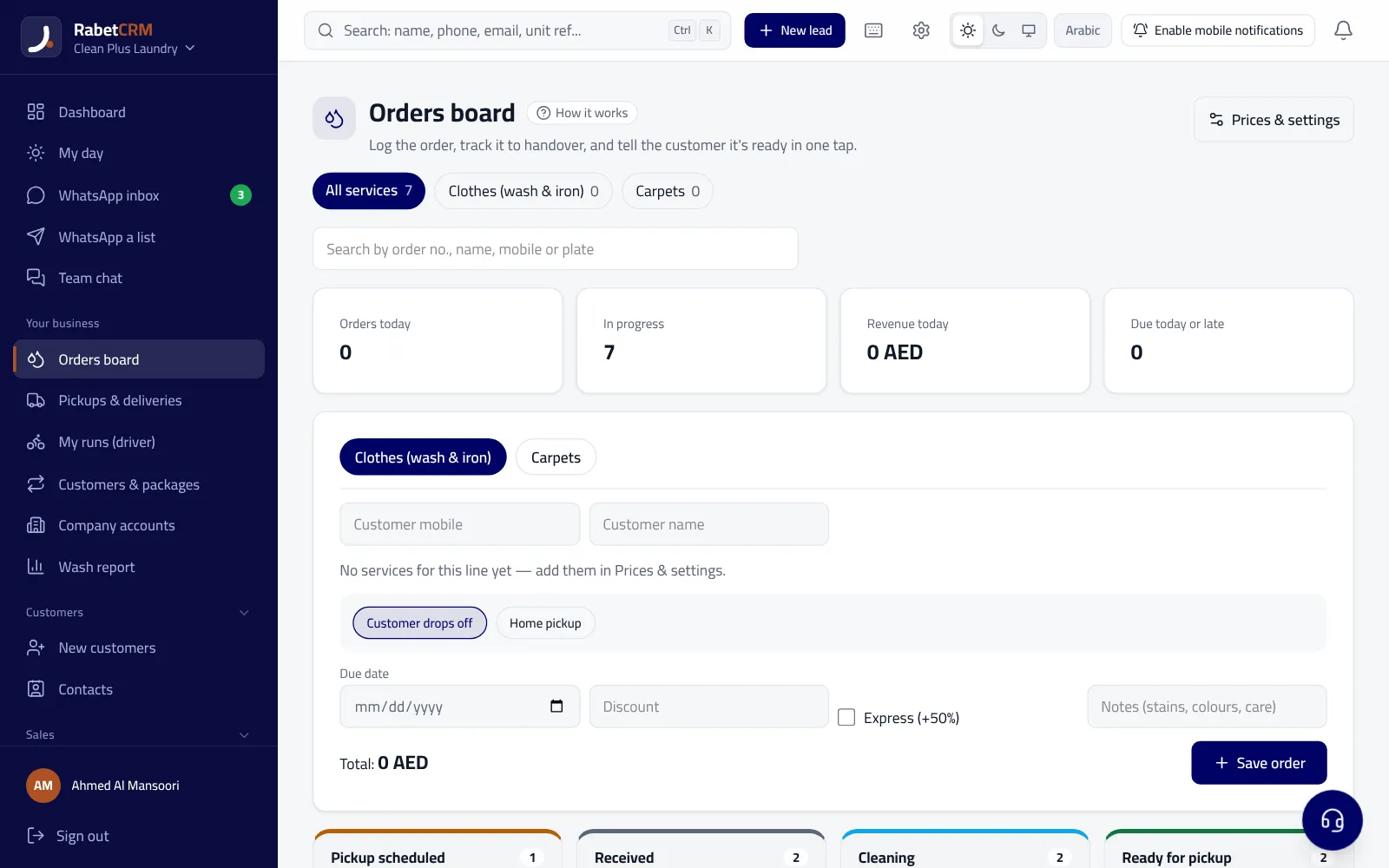
In RabetCRM's laundry software you set prices for each line in its own unit — clothes per item for each service, carpets and curtains per m², sofas per seat, mattresses per piece — and the order total is calculated automatically with a printable ticket for the customer. If you also run a car wash, you choose your lines at the start, each with its own prices and units.
Organising drivers and time slots: who does which run?
The biggest source of pickup and delivery complaints is timing: a driver two hours late, or a pickup nobody remembered. Start by splitting the day into clear time slots (morning and evening, for example), group orders by area for each driver to cut travel, and don't accept more orders per slot than the team can handle.
Then make each driver's status visible. In RabetCRM you assign a driver from your team to each order; they tap "On the way" then "Arrived", and you see them on the map. Drivers don't need a special app — they open "My runs" in their phone browser and share their location, and can install it as an app. The manager always knows where every driver is and which order they're on.
Consider combining pickups and deliveries on the same run. If a driver is delivering a finished order to a residential tower, it makes sense to collect new orders from that tower or the next block on the same trip. This simple planning cuts empty runs and lets each driver complete more orders without extra fuel or hours. Keep an eye on realistic turnaround for each service, too: everyday clothes may be ready in a day or two, while a large carpet that needs a full wash and dry takes longer, especially in humid months. Give customers a realistic delivery date from the start — a missed promise is worse than a slightly later date that's met.
Customer notifications: end the "where's my order?" calls
Every call from a customer asking about an order means a staff member stops to look it up. The fix is to get the information to customers before they ask. A WhatsApp message at the key moments is enough: when the pickup is confirmed, when the driver is on the way, and when the order is ready for delivery.
In RabetCRM, customers follow the driver through a tracking link sent in the "on the way" WhatsApp message, showing the order stage, the driver's location and a call button. A customer who can see the driver approaching is ready at the door, so waiting time at each address drops and drivers complete more runs per day.
- Pickup confirmation with the expected time
- "Driver on the way" with the tracking link
- A pickup summary with item count and estimated price
- "Your order is ready" with a proposed delivery time
Driver cash handover and regular customers
When drivers collect payment on delivery, cash sits outside the shop all day, and without a clear record it's hard to know in the evening what each driver should hand over. In RabetCRM you see the cash each driver holds, the supervisor taps "cash received" at handover, and a daily report shows cash, card and on-account, so the day closes with matching numbers.
Steady revenue comes from regulars: the family that sends laundry every week, the office that has its curtains cleaned periodically. Offer them prepaid per-item packages and watch for anyone late for their usual order. In RabetCRM you can send WhatsApp reminders to lapsed customers per line, so a carpet customer is reminded on a different rhythm from a weekly clothes customer. You can also share an online pickup request page with your laundry's name, where customers book a home pickup and you're notified instantly.
Get your laundry organised step by step
Don't change everything at once. Start by standardising order stages and recording item counts at pickup, then add driver assignment and "on the way" messages, and after that switch on the daily close and cash handovers. Within a few weeks you should see far fewer repeat calls and item disputes.
RabetCRM for clothes, carpet, sofa and curtain laundries brings per-item and per-m² orders, pickup and delivery with driver tracking, the customer tracking link, printed tickets, cash handovers and the daily close together, in Arabic and English. Also read our car wash loyalty guide for ideas on regulars, or start a 15-day free trial with no credit card.
More articles
FAQ
How do I organise laundry pickup and delivery orders?
Standardise the stages (request, driver assigned, collected, processing, ready, on the way, delivered), split the day into time slots, group orders by area per driver, and make every order's status visible to the whole team.
How do I stop items getting lost?
Count items in front of the customer at pickup and record them by type, tag or bag each order's items separately, and check the count before packing and before the driver leaves.
How is carpet and curtain cleaning priced?
Usually per square metre, measuring length and width at pickup. In RabetCRM for laundries you set a per-m² price for each line and the total is calculated automatically.
Does the delivery driver need a special app?
Not with RabetCRM — drivers open "My runs" in their phone browser and share their location, and can install it as an app if they like.
How can customers see where their order is without calling?
Send WhatsApp messages at the key stages with a tracking link showing the order stage, the driver's location and a call button — like RabetCRM's "on the way" message.