Distributing real estate leads to agents automatically: methods, rules and reassignment
Automatic lead distribution means every new lead is assigned to a specific agent the moment it arrives, following a stated rule: round robin among available agents, or by area, language, project or source. The rule is completed by a response-time condition — say, contact within 10 or 15 minutes — and if the agent doesn't make contact, the lead is reassigned to another agent and the manager is alerted. That stops leads from slipping and makes distribution fair and measurable.
Last updated:
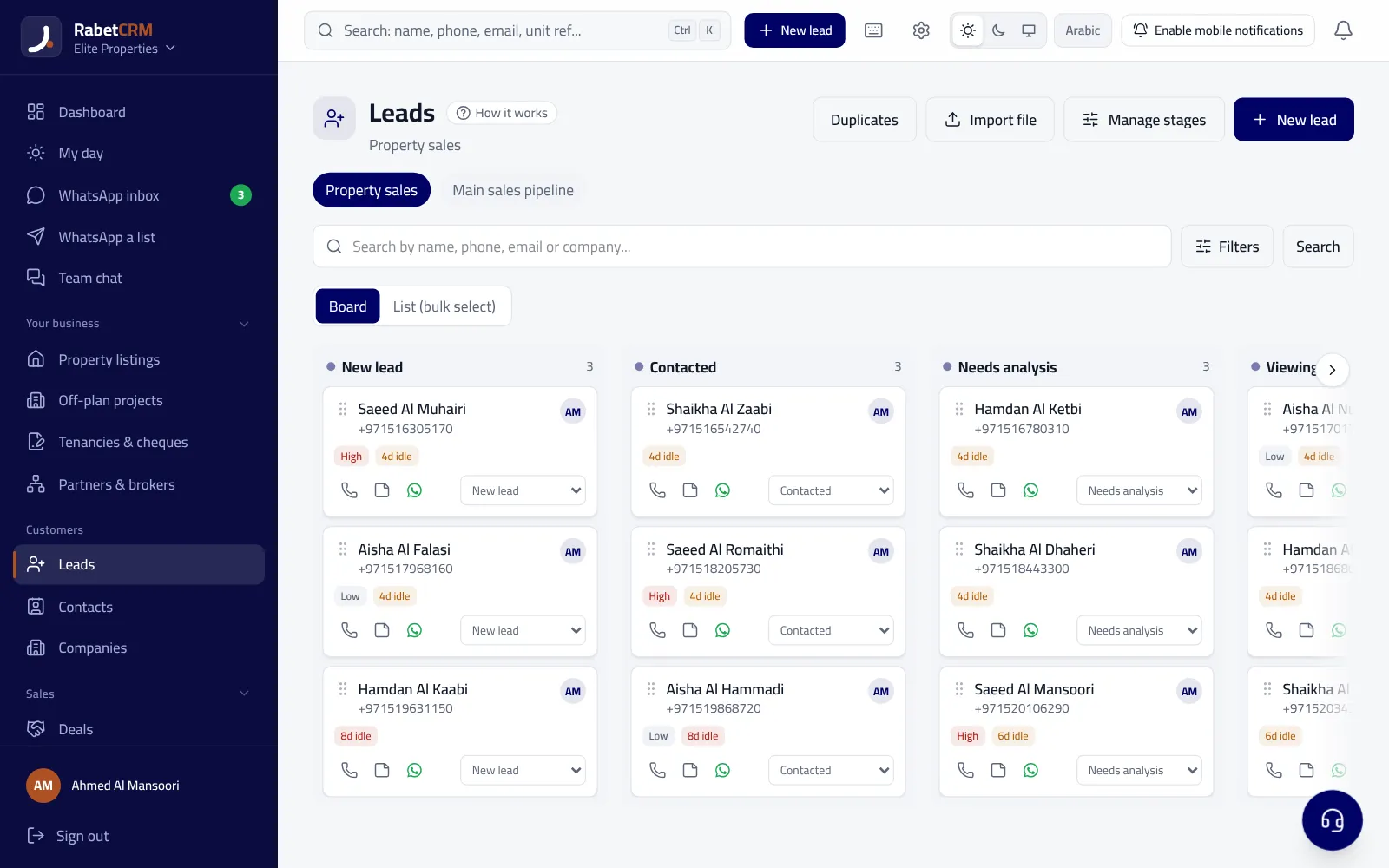
Why agencies lose leads with manual distribution
In many agencies a lead lands in the manager's inbox or a team WhatsApp group, then waits until someone decides who takes it. If the manager is in a meeting or a viewing, or the lead arrives in the evening, a long time can pass before first contact. In a market like the UAE, a client usually messages several agencies about the same unit, and the one that replies first with something useful tends to win.
Manual distribution has a second, less visible problem: fairness. When agents pick leads themselves, the fastest or the one closest to the manager takes the best ones, the rest feel short-changed, and arguments start over "whose lead is this". The third problem is measurement: without recorded distribution, you can't know how many leads each agent received, or how many they actually contacted.
The fix is written distribution rules that the system applies automatically, each with a clear time condition. The rest of this guide covers the common methods, when each one fits, and how to write response-time and reassignment rules.
Lead distribution methods compared
There's no single right method for every agency. A small office with five agents is usually fine with round robin, while a larger brokerage with specialised teams needs a mix of rules. The table below summarises the common methods with their pros and cons.
| Method | How it works | Best for | Watch out for |
|---|---|---|---|
| Round robin | Each new lead goes to the next agent in the list | Small or generalist teams | Skipping agents who are off or on leave |
| By area | Leads for each area or community go to its specialists | Agencies covering many areas | Busy areas overloading one agent |
| By language | Leads writing in a given language go to an agent who speaks it | International and overseas investor leads | Detecting language from the first message isn't always accurate |
| By project | Leads for a specific off-plan project go to its team | Agencies selling specific developer projects | Team availability outside launch periods |
| By source | Leads from a given portal or campaign go to a set team | Separating rentals from sales, or ads from portals | Leaving no source without a rule |
| Manual by manager | The manager reads the enquiry and picks the agent | Only very high-value leads | Delays when the manager is busy |
Round robin done right
Round robin is the best starting point for most agencies because it's simple, fair and easy to explain. But applied literally, it can send a lead to an agent who's on leave or off shift. So keep a clear list of who's in the rotation and update it daily: remove agents who are absent, travelling or still in training, and add them back when they're ready.
A common mistake is measuring fairness by lead count alone. Ten leads from a sales portal aren't the same as ten from a low-budget rental campaign. If sources differ in quality, run the rotation within each source or lead type separately, and review distribution monthly alongside the performance report.
- Define who's in the rotation and update it for leave and shifts
- Run separate rotations per lead type if quality differs
- Don't give new agents portal leads before reply training
- Review lead counts and outcomes per agent every month
Routing by area, language and project
As an agency grows, specialisation appears: one agent knows Dubai Marina well, another specialises in villas, a third speaks Russian or Hindi, and a team owns a specific off-plan project. Routing by specialisation helps here, because the client gets an agent who understands the question from the first message. The simplest approach is to define a group of agents for each specialisation and rotate within each group.
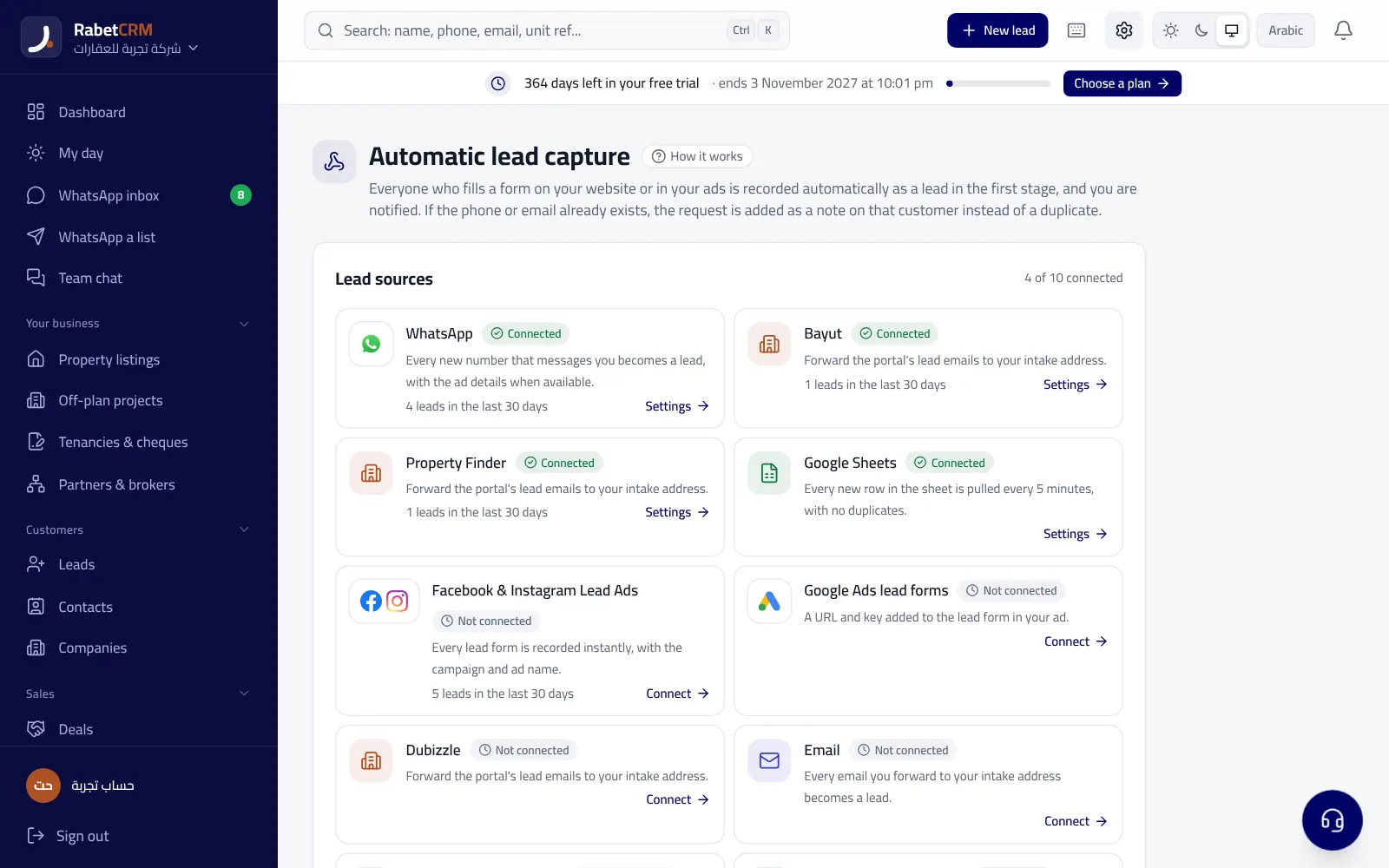
Area and project can usually be inferred from the listing reference the client asked about, which is why that reference must arrive with every portal lead, as we explain in capturing Bayut and Property Finder leads. Language is harder to detect automatically: some agencies infer it from the first message, some from an ad campaign aimed at a given language, and some let the manager transfer the lead manually after the welcome.
The most important rule here is the fallback: if a lead matches no specialisation, or no agent in the group is available, where does it go? Write the answer down explicitly — for example, the general rotation for the whole team — so no lead is ever left unassigned.
Response-time rules: how many minutes does an agent get?
Distribution alone isn't enough: assigning a lead to an agent doesn't mean the agent contacted them. Every distribution setup needs a time condition: the agent must contact the lead within a set period. Choose it to fit your agency; many start with 10 or 15 minutes during working hours, then tighten it gradually as the team adjusts.
Define clearly what counts as contact: a logged call, a WhatsApp message from the agent, or a follow-up note on the lead. Don't count the automatic welcome; it reassures the client that the message arrived and names the agent, but it doesn't answer their question. Also define what happens outside working hours: is a reply expected next morning, or is there an on-duty agent in the evening and at weekends? For welcome and follow-up templates, see real estate WhatsApp follow-up.
Reassigning ignored leads
Reassignment is what makes a response-time rule real. If the time passes without contact, the lead moves to the next agent and the manager is alerted. It's best to reassign only once and then have the manager step in, because passing a lead through many agents wastes time and suggests the problem is the client rather than the team.
There's a second kind of neglect that doesn't show in the first few minutes: a lead the agent contacted once and then stopped following up for weeks. Set a rule for that too, such as a weekly review of every open lead not contacted for a while, followed by either a follow-up task for the same agent or a transfer to another agent if it keeps happening. And write a lead-ownership policy in advance: when a lead stays with the agent, when it returns to the team, and how commission is split if another agent closes. A written policy prevents most disputes before they start.
- Reassign once, then escalate to the manager
- Review open leads with no recent contact every week
- Write a lead-ownership and commission-split policy for transfers
- Don't penalise an agent for a transferred lead without checking why
How to measure whether distribution works
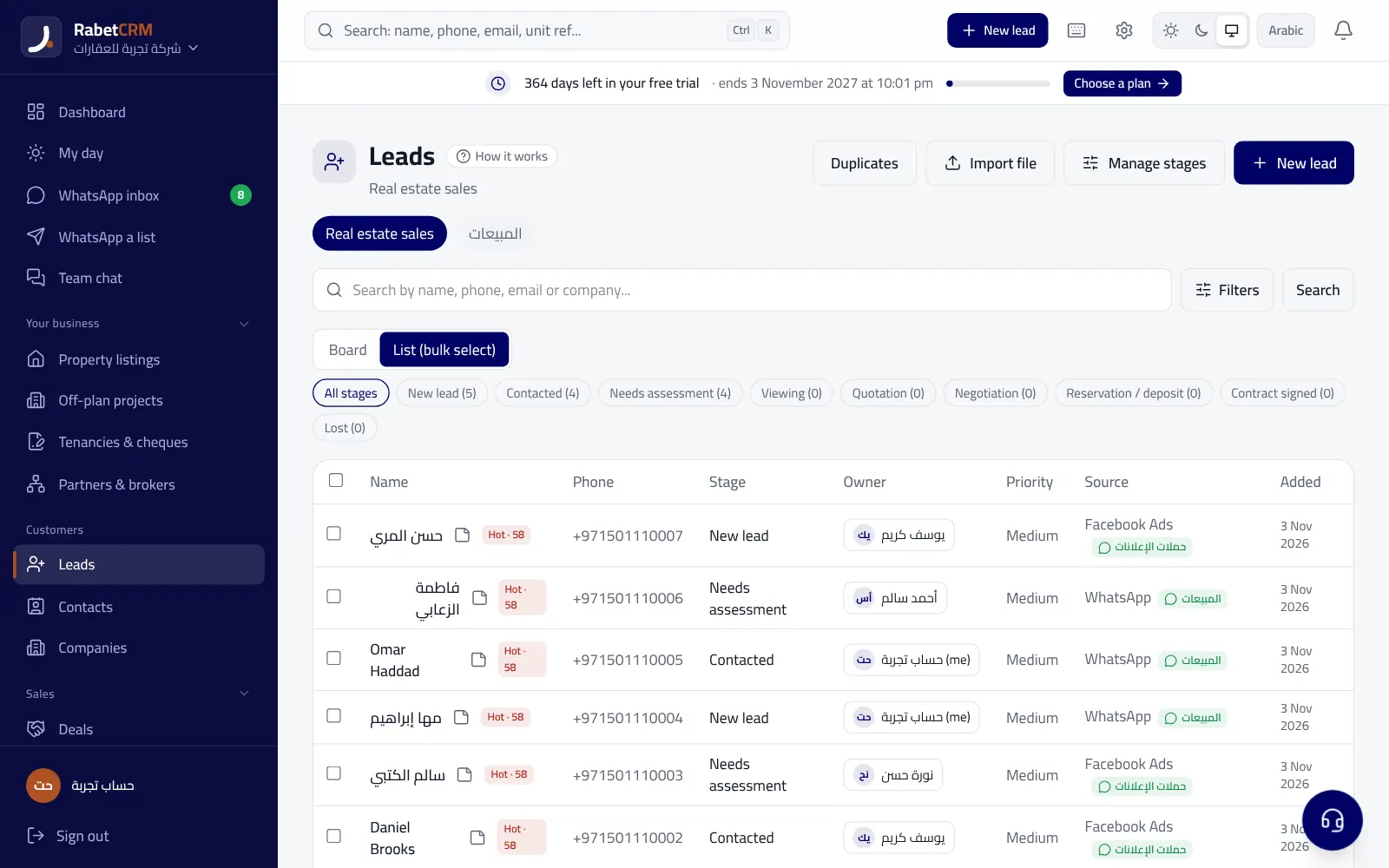
After a month of automatic distribution, review four numbers per agent: leads received, average time to first contact, how often leads were reassigned away from them, and the share that reached a viewing. If an agent receives many leads and many get reassigned, the problem is usually workload or training, not the rule. For these numbers and their formulas, see the agent performance report: 8 key numbers.
Common lead distribution mistakes and how to avoid them
Even the best routing rules fail if they're applied without follow-through. Most problems we see in agencies aren't about the system itself but about small decisions that pile up: an agent left in the rotation while travelling, a new source added with no rule, or a manager overriding the rules for a favoured agent until the team stops trusting the distribution. Review the list below monthly alongside the performance report.
- Leaving absent or on-leave agents in the rotation
- Adding a new lead source without a routing rule
- Counting the automatic welcome as agent contact
- Passing a lead through many agents instead of escalating
- Overriding the rules manually without a written reason
- Not recording the lead source, which breaks ROI measurement later
Automatic distribution in RabetCRM
In RabetCRM for real estate you turn on automatic distribution from the lead routing and response-time settings: choose the agents in the rotation, and you can also route by area or source. Then set how long an agent has to contact a lead; if they don't, the lead moves to the next agent once and you and your admins are alerted. You can send new leads an instant WhatsApp welcome from your company number with the lead's and the agent's names, and reports show each agent's response time and the open leads that haven't been contacted recently. Routing by language or project can be handled in practice by the manager transferring the lead after the welcome.
Start a 15-day free trial with no credit card, turn on routing on day one, and compare response times after two weeks with what they were before.
More articles
Real estate CRM in every emirate
Compare RabetCRM
FAQ
What is round robin lead distribution?
Each new lead automatically goes to the next agent on a set list, so every available agent gets a roughly equal share of leads with no manual step.
How long should an agent have before a lead is reassigned?
There's no single mandatory number, but many agencies start with 10 to 15 minutes during working hours and adjust for team size and lead volume. What matters is that the time is written down and known to everyone.
Is routing by area better than round robin?
Routing by area is better when you genuinely have agents specialised in different areas; round robin suits smaller teams. Many agencies combine them: a group per area, with round robin inside each group.
What should I do with a lead the agent contacted once and then neglected?
Review open leads with no recent contact every week, create a follow-up task for the same agent, and if it keeps happening, move the lead to another agent under a written ownership policy.
Is an automatic WhatsApp welcome enough as a first reply?
No. The automatic welcome reassures the client and names the agent, but it must be followed within minutes by a personal reply that answers their question, and it shouldn't count toward response time.