Managing off-plan property sales in the UAE: a practical guide for brokerages
Managing off-plan sales means tracking every unit you sell from booking to handover: the payment plan, the buyer's installments and due dates, registration with the authority (such as Oqood in Dubai), and your developer commission until it is actually received. The most organised brokerages in Dubai and Abu Dhabi run this in one system that reminds the team before every installment, instead of scattered spreadsheets where dates and commissions slip.
Last updated:
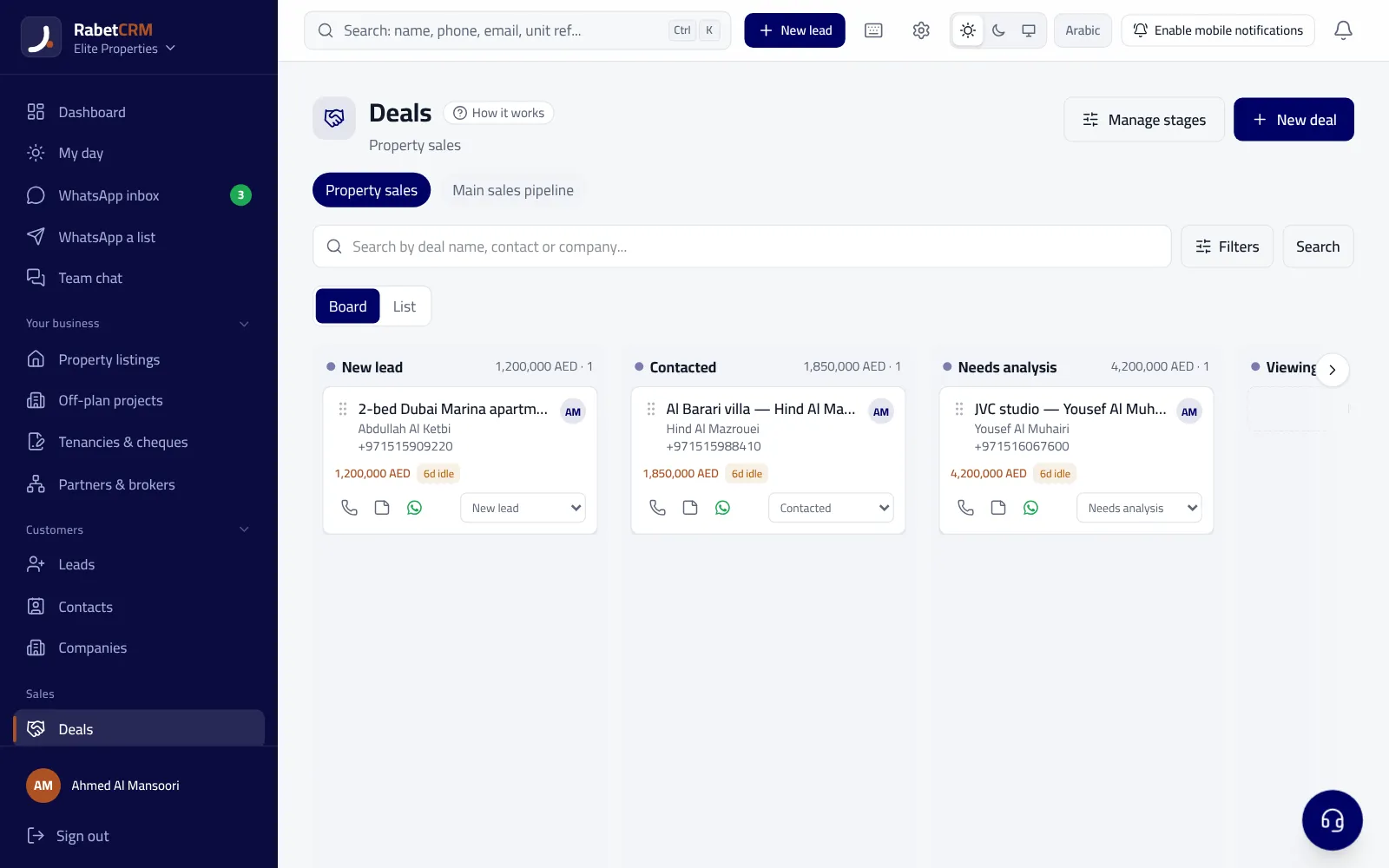
What does off-plan sales management involve for a brokerage?
An off-plan deal doesn't end when the client signs. A ready-property sale usually closes within weeks, but with a project under construction your relationship with the buyer can run two or three years, or longer if the plan includes post-handover payments. Throughout that period the buyer pays installments tied to dates or construction milestones, the developer pays your commission under its agreement with you, and the investor keeps asking about handover dates and expected returns.
So a brokerage needs a clear track for every sold unit, not just a “sold” cell in a spreadsheet. The usual stages in the UAE look like this (details vary by developer and emirate):
- Expression of interest and booking (EOI / reservation) with the booking amount.
- Signing the sale and purchase agreement (SPA) with the developer.
- Registering the sale with the authority — in Dubai through the Dubai Land Department's Oqood system.
- Paying construction-period installments according to the payment plan.
- The handover payment, then any post-handover installments.
- Collecting the developer commission, and following up after handover for leasing or resale.
Common payment plans: 60/40, 80/20 and post-handover
The numbers in a plan's name usually mean: the share the buyer pays before handover, and the share paid on handover. In a 60/40 plan, for example, the buyer pays 60% during construction (including the booking amount) and 40% on handover. Post-handover plans defer part of the price for months or years after the buyer receives the unit. The table below shows illustrative examples only; each developer sets its own percentages and dates in its contract.
Worked example: a AED 1,500,000 unit on a 60/40 plan split as 10% booking, 50% during construction and 40% on handover. Booking = AED 150,000, construction payments = AED 750,000 (usually split across several installments), handover = AED 600,000. Remember the buyer also pays registration costs; check Dubai Land Department fees and the property buying costs calculator before you quote a final number.
Practical tip: record the payment plan exactly as the developer's offer states it (percentage and date or milestone for each payment) instead of just “60/40”. Two plans with the same name can differ in how payments are split and scheduled, and the buyer will ask you for the exact amount of the next installment.
| Plan (example) | Booking | During construction | On handover | Post-handover |
|---|---|---|---|---|
| 60/40 | 10% | 50% | 40% | — |
| 80/20 | 20% | 60% | 20% | — |
| 50/50 | 20% | 30% | 50% | — |
| 40/60 post-handover | 10% | 30% | — | 60% in installments after handover |
How do you track buyer installments and due dates without missing one?
The buyer pays the developer, not the broker, but when an installment is late you are usually the first person the developer or the buyer calls. A late installment can also delay your commission when its release depends on the percentage paid. Organised installment tracking protects your income; it isn't just an extra service.
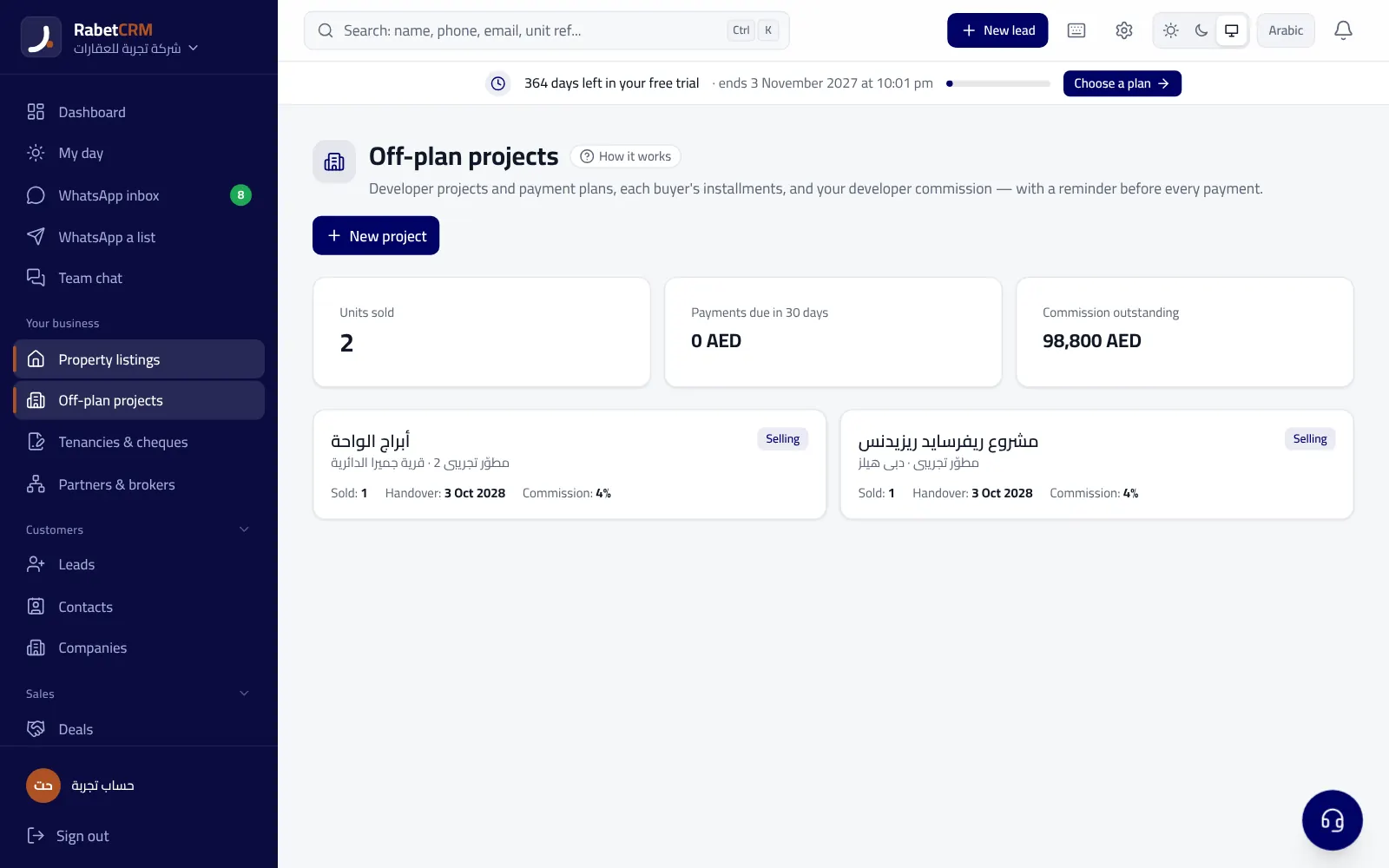
The practical approach: enter each project once with its payment plan and your commission rate, then record every unit you sell with its price and booking date, so the installments are generated with amounts and dates automatically. The Off-plan projects section in RabetCRM's real estate CRM works this way: pick a preset plan (60/40, 80/20 or 50/50) or adjust it to the project, add post-handover payments as steps a number of months after booking, and the team gets a reminder a week before each installment with a ready button to send the buyer a WhatsApp reminder.
- For each installment record: sequence, name (booking, construction, handover), amount, due date and status (due / paid).
- When the developer moves the handover date, update the handover payment immediately so the buyer doesn't get a wrong reminder.
- Send the reminder about a week before the due date, then confirm payment afterwards — don't rely on an agent's memory.
- Give the manager a weekly “payments due in 30 days” list across all projects.
- Never take installment money into the brokerage account; always direct the buyer to the account named in the SPA.
Escrow accounts and Oqood registration: what should a broker know?
In Dubai, Law No. (8) of 2007 governs escrow accounts for real estate development: a developer that wants to sell units off-plan must apply to the Dubai Land Department to open a project escrow account with an approved bank, and buyers' payments are deposited there to be spent on building the project under the Department's controls. That is why buyers should always pay into the escrow account named in their contract, and why a broker should confirm a project is registered before marketing it.
For registration, Law No. (13) of 2008 created the Interim Real Property Register to record off-plan sale contracts before they move to the main property register when the project completes, and Oqood is the online system Dubai uses to register these contracts. Registration usually triggers the Dubai Land Department fee (4% of the price) plus admin fees, and developers sometimes cover part of it as a promotion. Fees and timelines can change, so confirm current figures with the Dubai Land Department before quoting a client.
In Abu Dhabi the sector is governed by Law No. (3) of 2015 and its amendments, which require a dedicated escrow account for each off-plan project. Each emirate has its own authority and procedures, so if you sell projects in Abu Dhabi, Sharjah or Ras Al Khaimah, check with that emirate's real estate authority. This article is general guidance, not legal advice.
Developer commission: when is it paid and how do you track it until it's received?
In off-plan sales the commission is usually paid by the developer, not the buyer, and its rate and release conditions are set by the agency agreement between you and the developer, not the buyer's contract. There is no single market rule: some developers release commission after the SPA is signed and registered, others require the buyer to have paid a set percentage of the price, and the agreement may let the developer claw the commission back if the sale is cancelled. Read each developer's terms and record them on the project.
The most expensive mistake is forgetting the commission after the sale: the agent has moved on, the invoice was never sent, and nobody follows up. The fix is a clear commission status on every sold unit — pending → invoiced → received — with the amount calculated automatically from the project's rate. If you split with an agent or a co-broker, work it out with the commission calculator and see the UAE real estate commission guide.
| Status | What it means | Next action |
|---|---|---|
| Pending | Sale recorded, invoice not sent yet | Check the release condition (registration or % paid) and invoice |
| Invoiced | Invoice is with the developer | Follow up with the developer's broker desk until paid |
| Received | Money is in the brokerage account | Pay the agent's share and close the file |
Handover follow-up: what to do before and after the date
Handover is the biggest moment in the buyer's journey: usually the largest payment in the plan, followed by the inspection and key collection. A brokerage that reaches out two or three months before handover earns the buyer's trust, makes sure they're ready for the payment, and opens the door to a second deal: leasing or reselling the unit.
- 90 days before: remind the buyer of the handover amount and ask whether they'll need a mortgage.
- 30 days before: confirm the handover date with the developer and update it in the system if it changed.
- At handover: help arrange the unit inspection (snagging) and key collection.
- After handover: offer to lease it with a yield estimate from the rental yield calculator, then manage the contract and renewal as in the Ejari and renewals guide.
- If the plan has post-handover payments, keep reminding the buyer exactly as during construction.
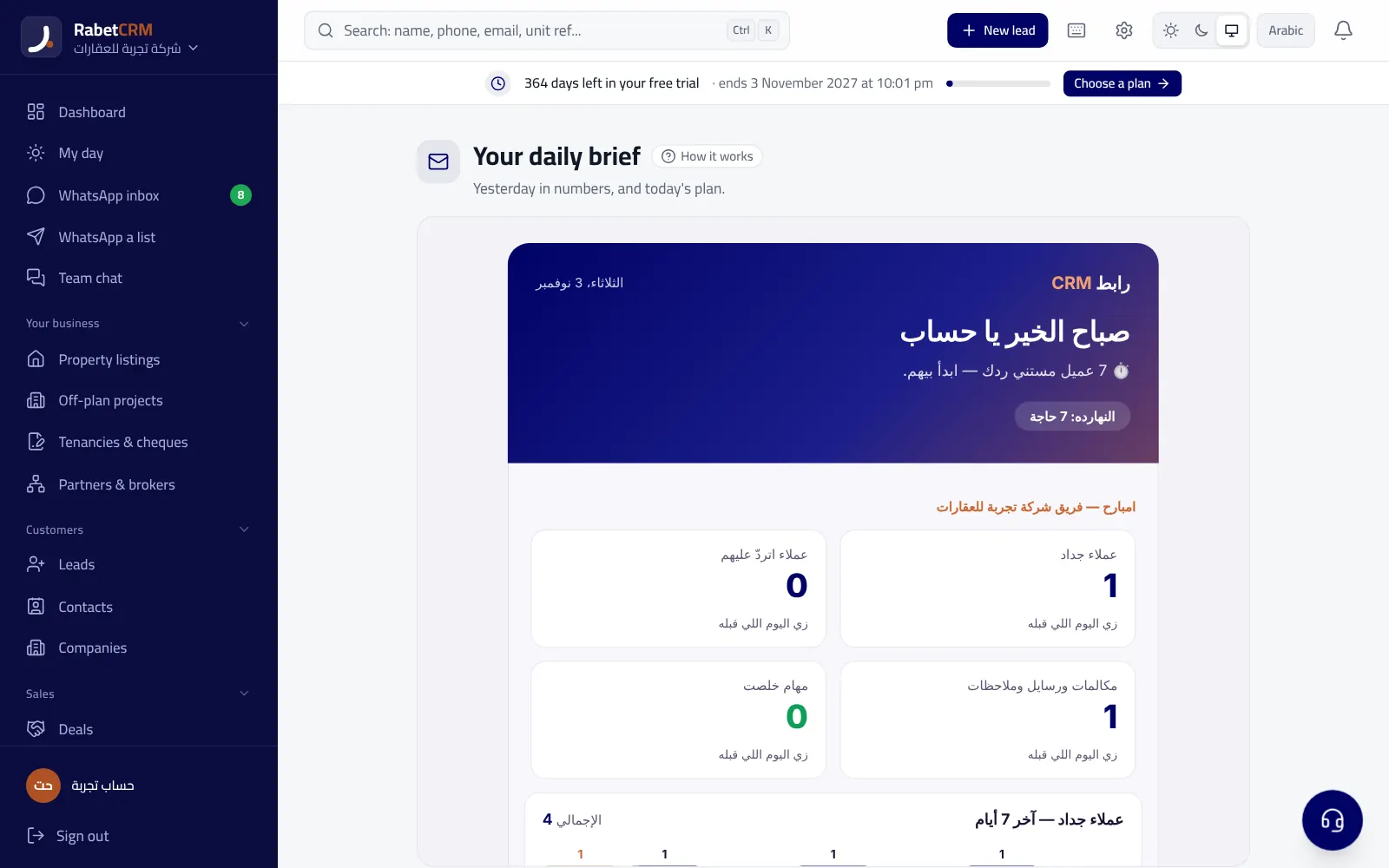
How do you serve off-plan investors and run the whole process in a CRM?
Many off-plan buyers are investors, some outside the UAE, often buying several units across several projects. They want quick answers on WhatsApp: how much have I paid, what's left, when is the next installment, when is handover? If every unit has a page showing paid, remaining and next payment, anyone on the team can answer in a minute, even when the original agent is on leave.
In RabetCRM all of this lives in one place: developer projects with payment plans and commission rates, sold units with their installments and reminders, and a dashboard of units sold, payments due in 30 days and commission outstanding. Add a shared team WhatsApp inbox and automatic portal lead capture, and the investor stays in one file from the first message to handover. You can try it free for 15 days with no card from the sign-up page; see pricing for plans.
- Common mistake: one Excel sheet per agent, so the data leaves with them.
- Not updating a delayed handover date, so buyers get reminders with wrong dates.
- Leaving commission without a status or owner, so it slips for months.
- Marketing a project before confirming it's registered and its ads have the required permit — see Trakheesi and Madhmoun permits.
More articles
Real estate CRM in every emirate
Compare RabetCRM
FAQ
What does a 60/40 payment plan mean for off-plan property?
It usually means the buyer pays 60% of the price before handover (including the booking amount and construction-period installments) and 40% on handover. How the 60% is split and scheduled differs between developers, so always check the payment schedule in the contract.
What is a post-handover payment plan?
A plan where the buyer receives the unit before paying the full price and pays part of it in installments after handover over a period set by the developer. It suits investors who want to rent the unit out and pay installments from the rent, but terms vary by project.
What is Oqood in Dubai?
Oqood is the Dubai Land Department's system for registering off-plan sale contracts in the Interim Real Property Register created by Law No. (13) of 2008, before a title deed is issued once the project completes. Check current fees and procedures with the Department.
Does the buyer pay off-plan installments to the broker?
No. In Dubai, buyers' payments must go into the project's escrow account under Law No. (8) of 2007, and in Abu Dhabi Law No. (3) of 2015 and its amendments require an escrow account per project. The buyer pays into the account named in their contract.
When does the developer pay the broker's commission on an off-plan sale?
It's set by the agency agreement with each developer. It's commonly tied to the SPA being signed and registered, or to the buyer paying a set percentage of the price, and may include a clawback if the sale is cancelled. Record each project's condition and track the commission status until it's received.
Is there a CRM that manages off-plan installments and developer commission?
Yes. RabetCRM has an off-plan section: editable preset payment plans, installments generated automatically for each buyer with a reminder before each one, and developer commission tracked from pending to received, in Arabic and English.