Ejari and tenancy renewals in Dubai: a practical guide for leasing and property management agencies
Ejari is Dubai's tenancy contract registration system, run by the Real Estate Regulatory Agency (RERA) under the Dubai Land Department, and every residential or commercial lease must be registered in it — renewals included. Any change to the lease terms at renewal, including a rent increase, requires written notice at least 90 days before the contract expires unless the parties agree otherwise, and the increase itself is governed by the rental index. That's why a leasing agency needs to track each contract's Ejari number, expiry date and post-dated cheques.
Last updated:
What is Ejari and why is it mandatory?
Ejari — literally "my rent" in Arabic — is the online system RERA launched to register tenancy contracts in Dubai, under Law No. 26 of 2007 regulating relations between landlords and tenants, as amended by Law No. 33 of 2008. Registration makes the contract officially recorded with the government and protects both landlord and tenant.
In practice, an Ejari certificate is needed for many transactions: connecting DEWA electricity and water, some residency and family-sponsorship procedures, and filing any rental case at the Rental Dispute Centre. An unregistered contract leaves the landlord, the tenant and the agency in a weak position in any dispute.
Legally the duty to register sits with the landlord, but in most cases the tenant, the brokerage or the property manager actually handles it. A leasing agency that gets registration done quickly and correctly saves its clients time and earns their trust.
Ejari documents and fees
You can register online through the DLD's Dubai REST app, or in person at an approved Real Estate Services Trustee Centre. The document list varies slightly by property type and channel, but the following are the most commonly required.
Fees usually combine a registration fee, additional service charges and VAT, and the total depends on the channel: published sources cite roughly AED 175–180 for online registration and around AED 215–240 at service centres, sometimes more for commercial property. These are approximate and can change, so confirm the current fees on the DLD's official website or in the Dubai REST app before paying.
- The unified tenancy contract signed by landlord and tenant
- Tenant's Emirates ID (plus passport and visa for non-GCC nationals)
- A copy of the title deed and the landlord's ID or passport
- The property's DEWA premises number
- A power of attorney if someone signs on a party's behalf
- For commercial property: the tenant's trade licence
- For renewals: the previous contract or Ejari certificate
The 90-day notice: when must the tenant be told about new renewal terms?
Dubai's tenancy law, as amended by Law No. 33 of 2008, provides that a party wanting to change the contract terms at renewal, including the rent, must notify the other party in writing at least 90 days before the contract expires, unless the parties agreed otherwise in the contract. If that deadline passes without notice, a landlord is in a weak position to impose an increase at renewal.
Evicting a tenant at the end of the contract for specific reasons set out in the law — such as selling the property or the owner needing it for personal use — is a different case, and usually requires 12 months' notice served through a notary public or registered mail. These are legal rules that can depend on the facts, so confirm them on the DLD's website or with a legal adviser before sending any notice.
The practical lesson for agencies: start the renewal conversation with the landlord about 120 days before expiry, so the new rent decision is ready and the written notice reaches the tenant comfortably before the 90-day mark.
How much can rent go up in Dubai? The rental index, simplified
Rent increases at renewal in Dubai aren't free-form: they're governed by Decree No. 43 of 2013, which ties the allowed increase to how far the current rent sits below the average for similar units in the DLD's rental index. The bigger the gap below market, the higher the allowed increase, up to a maximum of 20%.
In January 2025 the DLD launched the Smart Rental Index, which rates buildings with stars based on factors such as build quality, maintenance, location and amenities, rather than relying on the area alone. Use the official rent increase calculator on the DLD website or the Dubai REST app for each unit before sending notice, as brackets and details can change. The table below summarises the brackets as commonly published, for guidance only.
| Current rent below market average by | Maximum allowed increase |
|---|---|
| Up to 10% | No increase |
| 11% to 20% | 5% |
| 21% to 30% | 10% |
| 31% to 40% | 15% |
| More than 40% | 20% |
Tracking post-dated cheques (PDCs) on tenancies
Rent in Dubai is usually paid with post-dated cheques: one, two, four or more across the year, depending on the agreement. Across dozens of contracts, manual tracking becomes a source of mistakes: a cheque date passes without deposit, or a bounced cheque reaches the landlord's ears weeks later.
Best practice is a record for each cheque with its due date, amount and status (pending, deposited, cleared, bounced), a reminder before each cheque date, and a clear report for the landlord on what's been collected and what's late. If you manage units for investors, use the rental yield calculator to show them net yield after costs before a renewal or rent decision.
- Record cheque numbers, dates and amounts on signing day
- Track each cheque's status: pending, deposited, cleared or bounced
- Tell the landlord about any bounced cheque immediately and contact the tenant
- Collect the new year's cheques before the renewed term starts
A renewal reminder workflow so no lease slips
Renewals are a leasing agency's easiest recurring income — and the easiest to lose. A simple plan works well: a reminder at 90 days before expiry to send notice and settle the rent, at 60 days to confirm the tenant's intention, and at 30 days to prepare the new contract, the cheques and the new Ejari registration. Remember that a renewed lease needs its own Ejari registration.
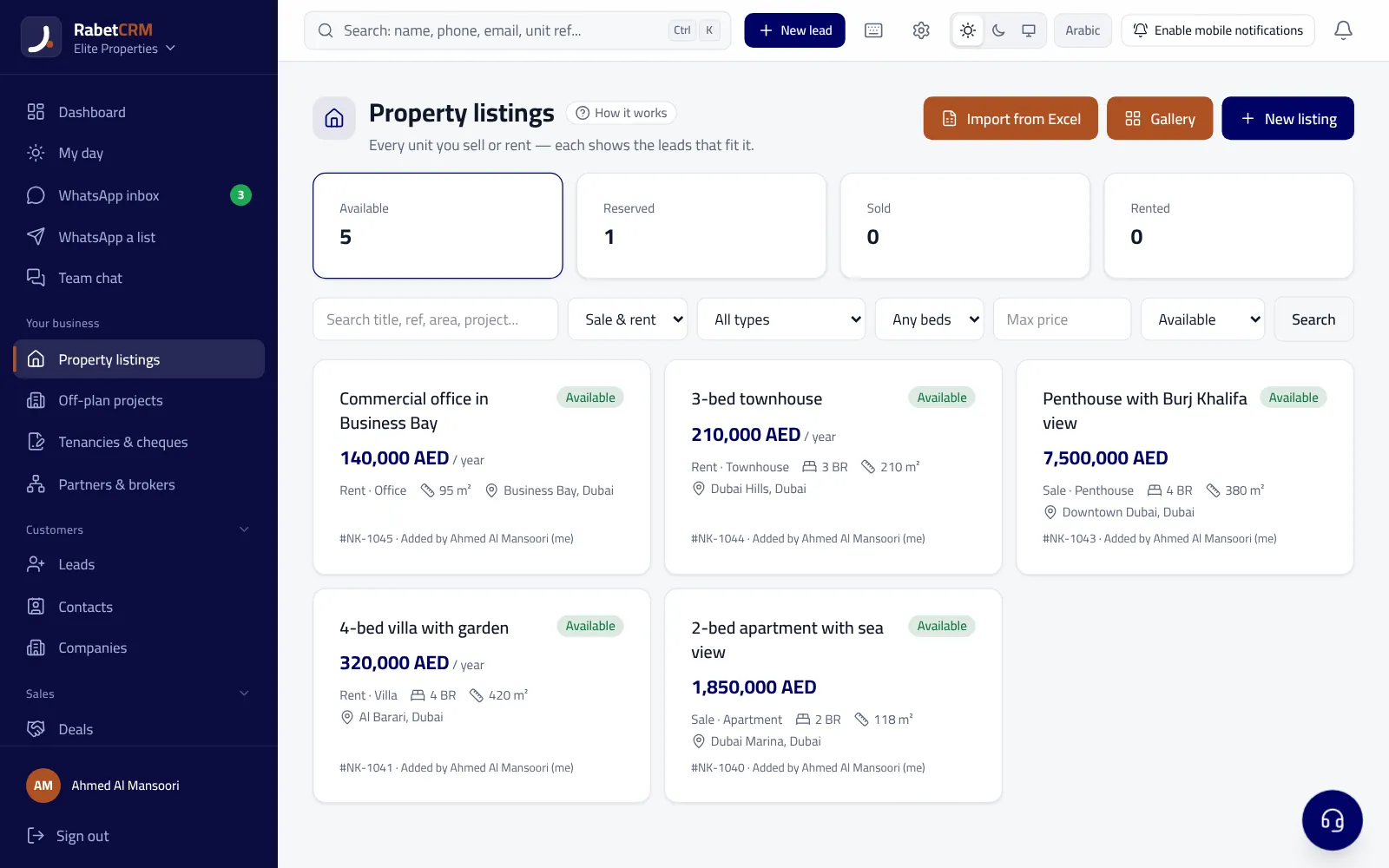
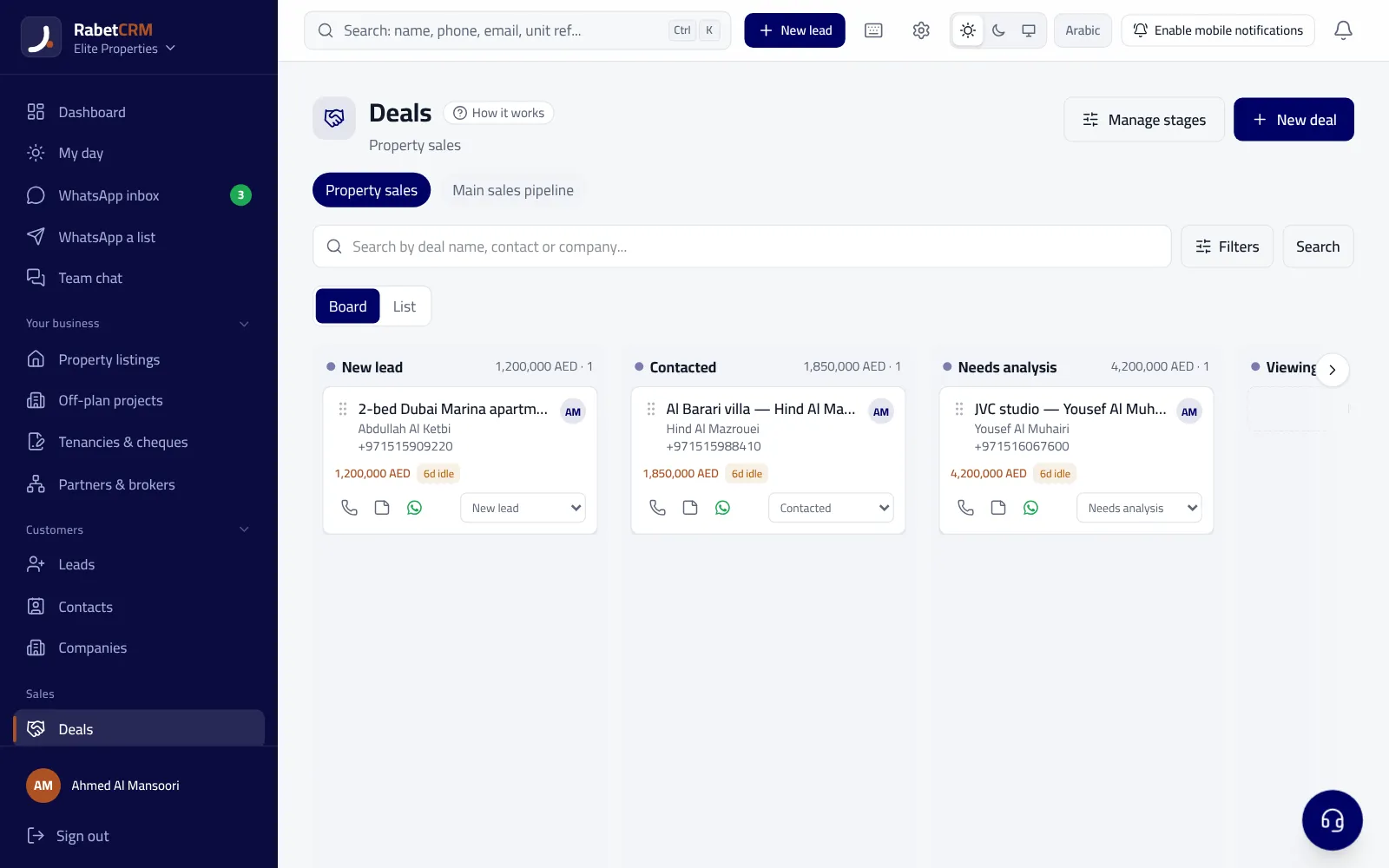
In RabetCRM for real estate you record landlords and tenancy contracts with each contract's Ejari number, the app generates the post-dated cheque schedule automatically from the rent and number of cheques, and you track each cheque's status (pending, deposited, cleared, bounced). You get an alert three days before each cheque is due and renewal reminders at 90, 60 and 30 days before expiry, then renew in one click: a new contract is created with a fresh cheque schedule and an empty field for the new Ejari number. You can also send each landlord a private link showing their units, contracts, cheques and renewals without logging in. Learn more on real estate CRM in Dubai, or start a 15-day free trial with no card; plan details are on pricing.
- 120 days out: review the rent with the landlord using the rental index
- 90 days out: send written notice of any change in terms
- 60 days out: confirm whether the tenant will renew or leave
- 30 days out: prepare the new contract and cheques and register Ejari
More articles
Real estate CRM in every emirate
Compare RabetCRM
FAQ
Is Ejari registration mandatory in Dubai?
Yes. Tenancy contracts in Dubai must be registered in Ejari under Law No. 26 of 2007 as amended. The legal duty sits with the landlord, though the tenant or the agency often handles it in practice.
How much does Ejari cost in 2026?
Published sources cite roughly AED 175–180 through the Dubai REST app and around AED 215–240 at service centres, including VAT. Fees can change, so confirm them on the DLD's official website before paying.
Do I need to renew Ejari when the lease is renewed?
Yes. A renewed lease is registered in Ejari as a new contract, usually with the previous contract or certificate details.
When must a landlord notify a tenant of a rent increase?
In writing at least 90 days before the contract expires, unless the contract says otherwise — and the increase must fall within what the rental index allows.
What is the maximum rent increase in Dubai?
Under Decree No. 43 of 2013 the cap is 20%, and only when the current rent is more than 40% below the market average. Calculate each unit's increase with the DLD's official calculator.
How can a leasing agency track PDCs and renewal dates?
With a system that records each cheque's date and status and reminds you before it's due and before the lease ends. In RabetCRM for real estate the cheque schedule is generated automatically, with reminders at 90, 60 and 30 days before expiry.