Patient follow-up for clinics, aesthetic and dental centres: a practical guide to fewer no-shows and completed treatment plans
A clinic cuts no-shows with three consistent steps: remind the patient on WhatsApp a day before and a few hours before the appointment, ask for an explicit confirmation so cancelled slots can be rebooked, and contact anyone who didn't show on the same day to reschedule. For multi-session treatments such as laser, aligners and physiotherapy, the next session date should be calculated automatically and the front desk should see every patient who is due or overdue, so nobody drops out halfway through a plan.
Last updated:
Why no-shows cost a clinic more than you think
A missed appointment isn't just an empty hour on the doctor's schedule. Behind every booking is the ad spend that brought the patient in on Instagram, TikTok or Snapchat, the receptionist's time spent following up and booking the consultation, and a room, device and assistant that were ready. When no-shows repeat, the schedule becomes unpredictable, and the clinic either overbooks or ends up with gaps it can't fill at the last minute.
In aesthetic, dental and dermatology centres the bigger loss usually isn't the first appointment but the sessions that follow. A patient who starts a six-session laser package and stops after the third won't get the result they expected, and will probably neither return nor recommend you. That's why patient follow-up isn't a side admin task — it decides whether your ad budget turns into recurring revenue or disappears after the first visit.
The good news is that most no-shows aren't a rejection of treatment; they're forgetfulness, a schedule clash, or a hesitation nobody answered. All of these can be fixed with a clear reminder and follow-up routine, which this guide walks through step by step.
The most common reasons patients miss appointments
Before choosing a tool or writing a message, understand why patients at your clinic in particular don't show up. Ask your front desk about the last twenty missed appointments and politely call a few of those patients to find out why. You'll usually find the same reasons repeating, and each one calls for a different fix in your follow-up routine.
| Reason | What fixes it |
|---|---|
| Forgetting, especially when booked weeks ahead | A reminder the day before and on the morning of the appointment |
| A clash with work or travel | A confirmation message that makes rescheduling easier than skipping |
| Hesitation over price or results after the consultation | Personal follow-up from the consultant or doctor to answer questions |
| Not knowing when the next session in the plan is due | Calculating the next date automatically and reminding as it approaches |
| A poor previous visit (for example a long wait) | A post-visit check-in about satisfaction and early handling of complaints |
A WhatsApp reminder schedule: when and what to send
WhatsApp is the main communication channel in the UAE and the Gulf, and patients read it far faster than email or SMS. But too many messages annoy patients and too few don't work. The schedule below is balanced and suits most clinics; adjust it to the type of service and how far ahead patients book.
Keep the message short and clear: the clinic name, the day, date and time, the doctor or a general description of the session, a map link, and a line asking the patient to confirm or reschedule. Avoid sensitive medical details such as the diagnosis or the exact procedure, since someone else may see the patient's phone. "Your appointment at the dermatology clinic" is enough — there's no need to name the condition.
Write messages in the patient's preferred language. Many UAE clinics serve both Arabic and non-Arabic speakers, and a message in the wrong language is less likely to be read and answered. Record the preferred language in the patient's file from the first contact.
- At booking: an instant confirmation with date, time and location
- The day before: a reminder asking the patient to confirm or reschedule
- On the morning or a few hours before: a short reminder with the map link
- An hour or two after a missed appointment: a friendly message to rebook
- After the visit: a check-in on the experience and the next session date if any
Confirmation and rebooking: turn an empty slot into an opportunity
A reminder tells the patient about the appointment; a confirmation tells you whether they'll come. Ask the patient to reply with one word or number to confirm or request another time, then update the appointment status straight away. An appointment still unconfirmed the day before deserves a phone call from the front desk, because the patient who ignores messages is often the one most likely to miss.
When a patient cancels early, don't treat it as a loss. Keep a short waiting list of patients who asked for an earlier slot, or who had a consultation but haven't started treatment, and message them with the opening. An early cancellation then becomes a new booking instead of an empty hour.
For a patient who actually missed, reach out the same day with a non-judgemental message offering a new time. The longer you wait, the less likely they return. Over time a pattern emerges: repeat no-shows deserve a call before every appointment, and perhaps a clear written late-cancellation policy explained when they book.
Multi-session treatment plans: making sure patients finish the course
In laser, clear aligners, physiotherapy and skin treatments, results depend on keeping to the interval between sessions. So the whole plan should be recorded from the start: number of sessions, the usual interval, what's done and what remains, and what's paid and outstanding. That way any receptionist, even one who didn't book the first session, knows exactly where the patient is in the plan.
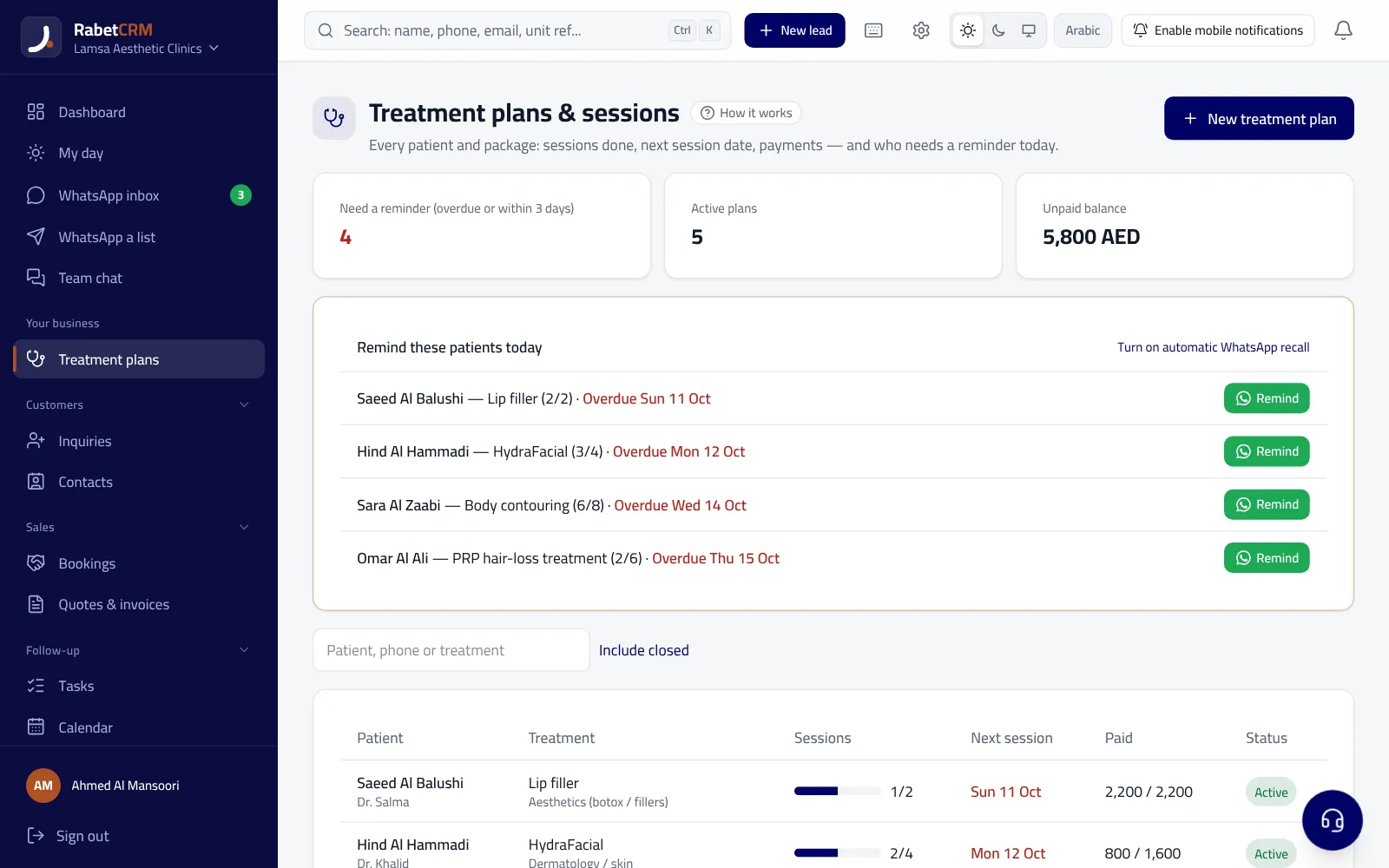
More important than recording is that the next session date is calculated automatically from the interval, and that every morning there's a list of patients who are due or overdue. In RabetCRM for clinics every session is logged against the treatment plan, the app calculates the next session date, and a daily list shows patients who are due or overdue so you can send each a WhatsApp reminder in one tap.
Mid-plan, a simple message reminding the patient of their progress — "you've completed 3 of 6 sessions" — encourages them to keep going. And if a patient is later than usual for a session, a call from the treating specialist is far more persuasive than an automated message, because they can explain how the delay affects the result.
Patient recalls: dental, aesthetic and dermatology
A recall invites a patient to come back after a set period even without an existing appointment, and it's one of the most neglected sources of recurring revenue in clinics. In dentistry it's usually the routine check-up and cleaning; in aesthetics, top-up or maintenance sessions after a few months; in dermatology, a review of treatment results.
Set an appropriate recall interval for each service based on your doctors' judgement, then make recalls part of the front desk's daily routine rather than a seasonal campaign. Start with patients who finished treatment with a good result — they're the most likely to return and to refer friends.
- Dental: routine check-up and cleaning at the interval the dentist sets for each patient
- Aesthetics: maintenance or top-up sessions after the package ends
- Dermatology and laser: reviewing results and assessing the need for more sessions
- Physiotherapy: a follow-up after the programme to check progress has held
Post-consultation follow-up: the patient who hasn't decided yet
Many patients attend a consultation and then say "I'll think about it." If nobody follows up, they'll often decide with another clinic that offered the same plan. Split the patient journey into clear stages — new request, consultation booked, plan offered, treatment started — and give each stage a specific, dated follow-up action.
In RabetCRM, Facebook, Instagram and WhatsApp requests flow in automatically with a stage for each step, so the clinic manager sees how many patients were offered a plan but haven't started, and who owns each follow-up. Good post-consultation follow-up answers something specific: sending the information you promised, explaining payment options if your clinic offers them, or proposing a date for the first session.
Patient data privacy in the UAE: what to keep in mind
Health data in the UAE is governed by its own law — Federal Law No. 2 of 2019 on the use of information and communication technology in health fields, and its executive regulations. It requires organisations to keep health data confidential and accurate, and restricts storing or processing health data about services provided in the UAE outside the country except where the authorities allow it. Other Gulf countries have their own data protection rules, so check what applies where you operate.
The practical advice: use your follow-up and booking system for communication, appointments and payments, and keep the detailed medical record (diagnoses, reports, clinical photos) in your approved clinical system. RabetCRM, for example, isn't an electronic medical records system but a CRM for sales, follow-up and bookings; its patient file holds the file number, insurance, ID, allergies, sessions and payments. Set staff permissions so each person sees only what they need, and don't send medical details over WhatsApp. This is general guidance, not legal advice — confirm your health authority's requirements with a legal adviser.
Set up patient follow-up at your clinic
You don't need a big project to start. Pick one service where patients often drop out, such as laser packages, apply the reminder, confirmation and missed-appointment routine for a month, and compare completed sessions before and after. Once you see the difference, roll it out to other services and add periodic recalls.
RabetCRM for clinics, aesthetic and dental centres captures ad and WhatsApp requests, books the consultation, tracks the treatment plan session by session, and tells you who needs a reminder. Start with one user and add receptionists and doctors later, in Arabic or English. Read more about WhatsApp CRM, or start a 15-day free trial with no credit card.
More articles
FAQ
How can I reduce patient no-shows?
Send WhatsApp reminders the day before and on the morning of the appointment, ask for an explicit confirmation, call anyone who hasn't confirmed, contact no-shows the same day to reschedule, and fill cancelled slots from a waiting list.
When should I send an appointment reminder?
Usually a confirmation at booking, a reminder the day before asking for confirmation, and a short reminder a few hours before. Adjust the timing to the service and how far ahead patients book.
How do I track patients on laser and multi-session packages?
Record the plan with the number of sessions and the interval, calculate the next date automatically, and review a daily list of who's due or overdue. RabetCRM for clinics does this automatically with one-tap WhatsApp reminders.
Is it OK to send appointment reminders over WhatsApp?
WhatsApp is widely used for reminders in the Gulf, but stick to the date, time and location without sensitive medical details, get the patient's consent to be contacted, and check your health authority's requirements.
Does a clinic CRM replace an electronic medical records system?
No. A CRM like RabetCRM is for sales, follow-up and bookings; the detailed medical record stays in your clinic's approved clinical system.