Managing car rental contracts and fleets in the UAE: availability, deposits, Salik, fines, maintenance and registration
Running a rental company well means knowing at any moment each car's status (available, rented, reserved, in maintenance), recording mileage, fuel and condition on every contract at handover and return, and holding a security deposit that covers Salik tolls and traffic fines that can surface after the return. Add service tracking by kilometres and alerts before each car's insurance and registration expire, so no car goes out with expired papers.
Last updated:
Where do car rental companies lose money?
A rental company's profit rarely leaks through the daily rate; it leaks through small details after the car leaves: a car returned with half a tank when fuel wasn't recorded at handover, extra kilometres never charged, a traffic fine that appears two weeks after the return when the deposit has already been refunded, or Salik charges piling up on the company's account without being passed to the renter.
On the other side there's an invisible loss: an available car sitting in the yard that the booking clerk didn't know about, two overlapping bookings for the same car, or a car grounded because its insurance or registration lapsed unnoticed. The bigger the fleet, the harder these details are to control in a spreadsheet or notebook.
Fleet availability: every car's status in one place
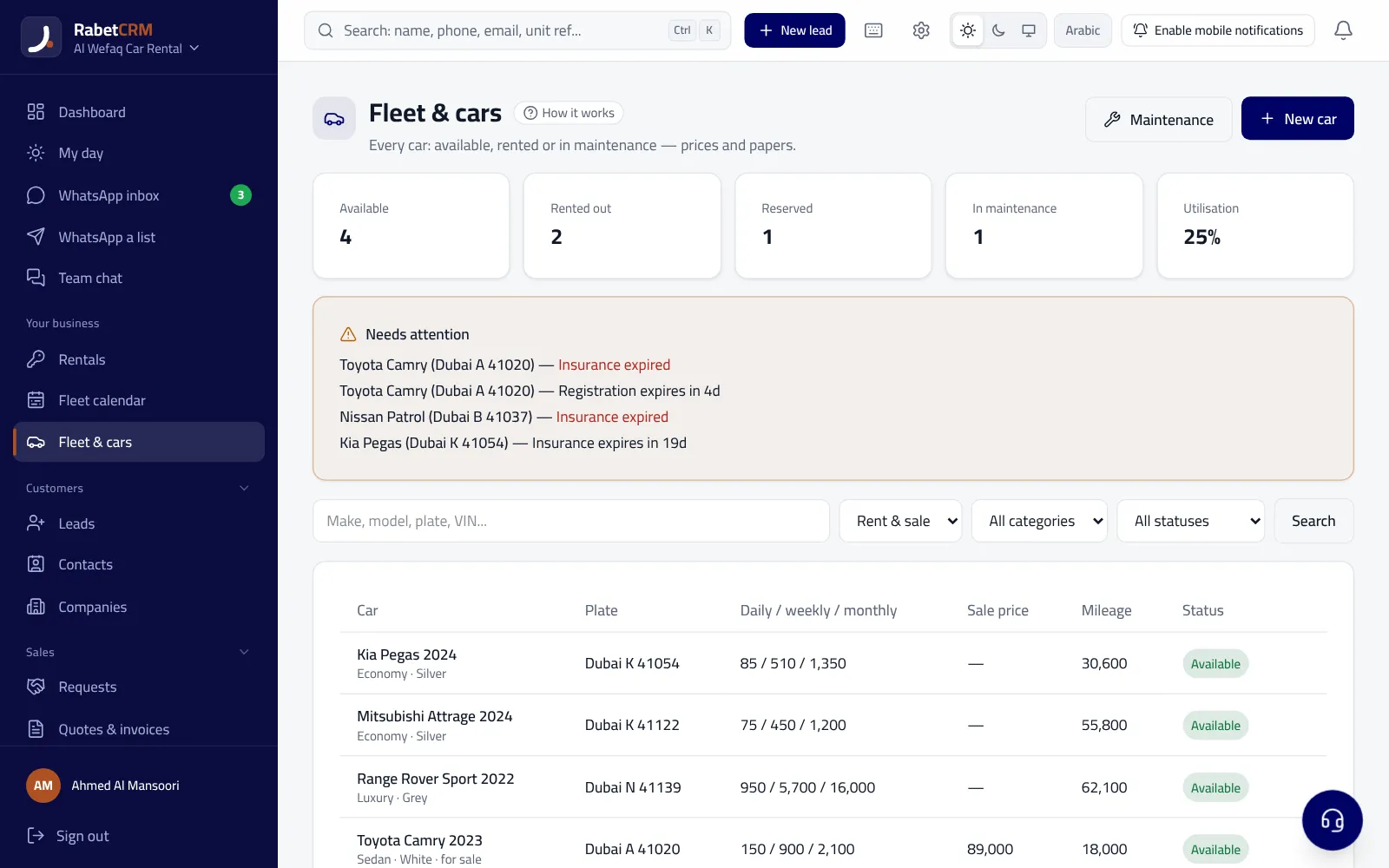
The foundation is a record per car with make, model, year, plate and VIN, category and seats, daily, weekly and monthly rates, and the current odometer. Then a clear status with no guesswork: available, rented, reserved or in maintenance. From that record a booking clerk can tell a customer right away what is actually free for the dates requested.
One key rule is blocking double bookings: before confirming any contract or extension, check the car isn't already booked for that period. And a per-car utilisation figure (how many days it was rented out of the period) reveals cars that cost more than they earn, so you can reprice them or list them for sale.
Start each day with three lists: who picks up today, who must return today, and who is overdue. The pickup list helps the yard team prepare, clean and fuel cars before customers arrive; the return list tells you which cars will free up for upcoming bookings; and the overdue list means an immediate call to confirm the return time or formally extend the contract, instead of leaving the car off the books.
What should a car rental contract include?
The contract is your reference in any dispute, so it must be complete at handover, not after. Detailed legal and insurance terms vary by emirate and by the authority licensing your activity, so check the requirements of Dubai's Roads and Transport Authority (RTA) or the competent authority in your emirate, and your insurer's terms. But the following items are essential in any practical contract:
- Renter details: name, mobile and Emirates ID, residence or passport number
- Driving licence number and expiry
- The car and its plate, and pickup and return date and time
- Rate type (daily, weekly, monthly) and kilometres allowed per day
- Odometer and fuel level out and in
- Condition notes (scratches, cleanliness) with photos at handover
- Deposit amount and the terms for refunding it
- How Salik, fines, damage and admin fees are charged
Security deposits: when to hold and when to refund
Most rental companies in the UAE hold a cash deposit or a card authorisation to cover damage, Salik tolls and traffic fines that may surface after the return. The reason is practical: a fine or toll charge may not show on the company's account the moment it happens, but days or weeks later.
Best practice is to set a clear refund period after return in the contract and, before refunding, check the fines and toll charges recorded against the car during the rental. Each contract should record the deposit amount and its status (not yet returned, returned), so no customer's deposit is forgotten for months and becomes a complaint, and none is refunded before charges are checked, leaving the company to absorb them. Typical refund periods differ between companies, so rely on what your contract states and any requirements from the competent authority in your emirate.
Recovering Salik tolls and traffic fines
Salik is Dubai's electronic road toll gate system, and its charges are deducted from the account linked to the vehicle — for rental cars, the owning company's account. Abu Dhabi runs a similar toll gate system called Darb. Likewise, traffic fines are recorded against the vehicle and its owner, and the rental company passes them on to the renter who was driving under the contract. So the contract must state clearly that tolls and fines during the rental period are the renter's responsibility, along with any admin fee the company adds.
In practice, the safest method is to match each toll or fine by date and time to the contract the car was on at that moment, then record it as an extra charge on that contract and notify the customer clearly. Check toll prices, policies and fines on the official Salik and RTA websites since they can change, and don't rely on figures copied from unofficial sources.
To avoid disputes, send the customer the details of each extra charge: date, time, location and amount, with a reference to the contract clause that covers it. Transparency protects your reputation, because a customer surprised by an unexplained deduction from their deposit may leave a negative review even when the deduction is correct. If you operate in more than one emirate or Gulf country, document each one's toll and fine systems in the contract.
| Extra charge | When it appears | How to track it |
|---|---|---|
| Extra kilometres | At return | Compare odometer to daily allowance × days |
| Fuel difference | At return | Record fuel level out and in |
| Salik / Darb tolls | After passing a gate, sometimes delayed | Match date and time to the contract period |
| Traffic fines | Can appear days or weeks later | Check before refunding the deposit and log on the contract |
| Damage | At return | Compare with handover photos and notes |
Maintenance, insurance and registration renewal
An unplanned grounded car costs twice: lost income and bookings that must be reshuffled. So tie routine service to the odometer: record each car's "next service at km", update the odometer on every return, and you'll know which car is close to service before renting it out for a month. After each return, flag the car if it needs maintenance or cleaning before the next rental.
Vehicle registration (mulkiya) is renewed periodically and usually requires valid insurance, and may require a technical inspection depending on the car's age and type and the emirate's rules. A car must not be driven with expired registration or insurance, so you need an alert well before each expires to arrange renewal without grounding the car. Check current renewal requirements on the RTA website or with the competent authority in your emirate.
Rental and sales in one business
Many rental companies in the Gulf sell their used cars after a while, and many dealerships also rent. A purchase customer differs from a rental customer: a longer decision, a VAT-inclusive quote, a test drive, and maybe financing and a reservation deposit. So it helps to make each customer's request type clear (daily rental, monthly, new or used purchase, trade-in) and to list a car for rent or for sale from the same record.
Requests arrive from many channels at once: Facebook and Instagram ads, WhatsApp and phone. A customer asking about a rental usually messages several companies, and the fastest to reply with a clear price and confirmed availability wins the booking.
Don't forget monthly and corporate customers, who are the most valuable over time. A monthly renter needs a check-in before each month ends to confirm an extension or return, and a company renting several cars for its staff needs a clear statement of contracts, amounts and extra charges per car. A reminder before the return or extension date prevents overruns and protects your upcoming bookings.
How RabetCRM helps you manage fleet and contracts
In RabetCRM for car rental and dealerships you record each car with its status (available, rented, reserved, in maintenance), daily, weekly and monthly rates, mileage and next service by kilometres, with alerts before insurance and registration expire. When you create a rental, it checks the car isn't booked for the same period and calculates the total, records mileage and fuel at handover and return, the deposit and whether it's been returned, and extra charges (extra km, fuel, fines, damage).
Every day you see who picks up, who must return and who's overdue, and you can extend a rental with a clash check against other bookings. The customer file keeps their licence number and expiry and ID, Facebook/Instagram lead ads and WhatsApp requests arrive directly, and purchase customers get VAT quotes plus financing and deposit fields. Learn more on the car rental software page, or start a 15-day free trial with no card.
More articles
FAQ
Who pays traffic fines on a rental car in the UAE?
The fine is recorded against the car and its owner (the rental company), which then passes it to the renter driving at the time under the contract, sometimes with an admin fee the contract specifies.
How are Salik tolls charged on rental cars?
Salik tolls are deducted from the company's account linked to the car, and the company then charges the renter per the contract, usually at or after return. Check Salik's official policies and state the charging method and any admin fee in the contract.
Why do rental companies hold the deposit after the car is returned?
Because fines and toll charges can appear days or weeks after return. What matters is a clear refund period in the contract and the company checking charges, then refunding without delay.
How can I quickly see which cars in my fleet are available?
With a record per car whose status (available, rented, reserved, in maintenance) updates automatically with every handover and return, and a block on overlapping bookings for the same car.
Is there Arabic software for managing car rentals?
Yes — RabetCRM has an Arabic and English interface and manages fleet, contracts, deposits, extra charges and insurance/registration alerts, with a 15-day free trial and no card.