Running a courier and delivery company: shipment tracking, driver assignment and cash-on-delivery reconciliation with merchants
A courier company needs four things to run well: entering merchants' shipments quickly with a unique AWB number for each, assigning them to drivers by area, keeping receivers informed with a tracking link and WhatsApp updates, and settling cash-on-delivery with each merchant after deducting shipping fees. Accurate settlement starts with every shipment having a recorded COD amount and a clear status: delivered, returned or postponed.
Last updated:
The daily challenges of a Gulf delivery company
The growth of e-commerce and selling over Instagram and WhatsApp in the UAE and the Gulf has created strong demand for small and mid-sized delivery companies serving online stores, restaurants, pharmacies and home businesses. Cash on delivery remains common with many buyers, especially with newer stores they don't yet trust, which makes the courier responsible for moving money as well as parcels.
The same challenges show up at almost every company: the merchant sends a shipment list in an Excel file or a WhatsApp message, and someone retypes it shipment by shipment. Receivers call to ask where their parcel is. Drivers come back in the evening with cash nobody can tie precisely to shipments. And at the end of the week the merchant asks for their money, and the answer takes hours of manual matching.
This guide walks through every stage of the shipment cycle, from intake to settlement, and suggests an organised approach that cuts errors and builds trust with merchants and receivers.
Shipment intake: from manual entry to bulk import
Typing shipments in one at a time is fine at ten a day, but it becomes a bottleneck as you grow. Every shipment needs at least the receiver's name, phone number, address or area, the COD amount if any, and delivery notes. Every mistake in a phone number or amount means a wasted run or a dispute with the merchant.
The fix is to receive shipments from merchants in a standard format: agree fixed columns in an Excel file, then import them in one go. In RabetCRM for courier and delivery companies you copy the columns from Excel and paste them, creating dozens of shipments in seconds, each with its own AWB number.
- Receiver name and phone number (with country code)
- Emirate or city, area and full address
- COD amount, or zero if prepaid
- Contents description and number of pieces
- Delivery notes: preferred time, or call before arrival
The AWB and tracking number: a shipment's identity throughout
The air waybill (AWB) is the label stuck on the parcel, carrying a unique number that links the physical package to its record. It must be clear and easy for drivers to read: receiver name, phone, address and COD amount in large print, plus a code that can be scanned with a phone. A clear AWB cuts sorting errors and deliveries to the wrong person.
In RabetCRM you print a 100×150 mm AWB with a QR code — a common size for thermal label printers — and every shipment has a tracking page showing its movement history. Print AWBs as soon as shipments are entered and stick them on before parcels leave the warehouse, so no package is ever unlabelled.
Assigning shipments to drivers by area
Good assignment saves time and fuel. Divide your service area into fixed zones and give each driver a home zone whose streets and buildings they know. In large cities such as Dubai, Abu Dhabi and Riyadh, a big chunk of the day disappears when a driver criss-crosses the city for scattered deliveries.
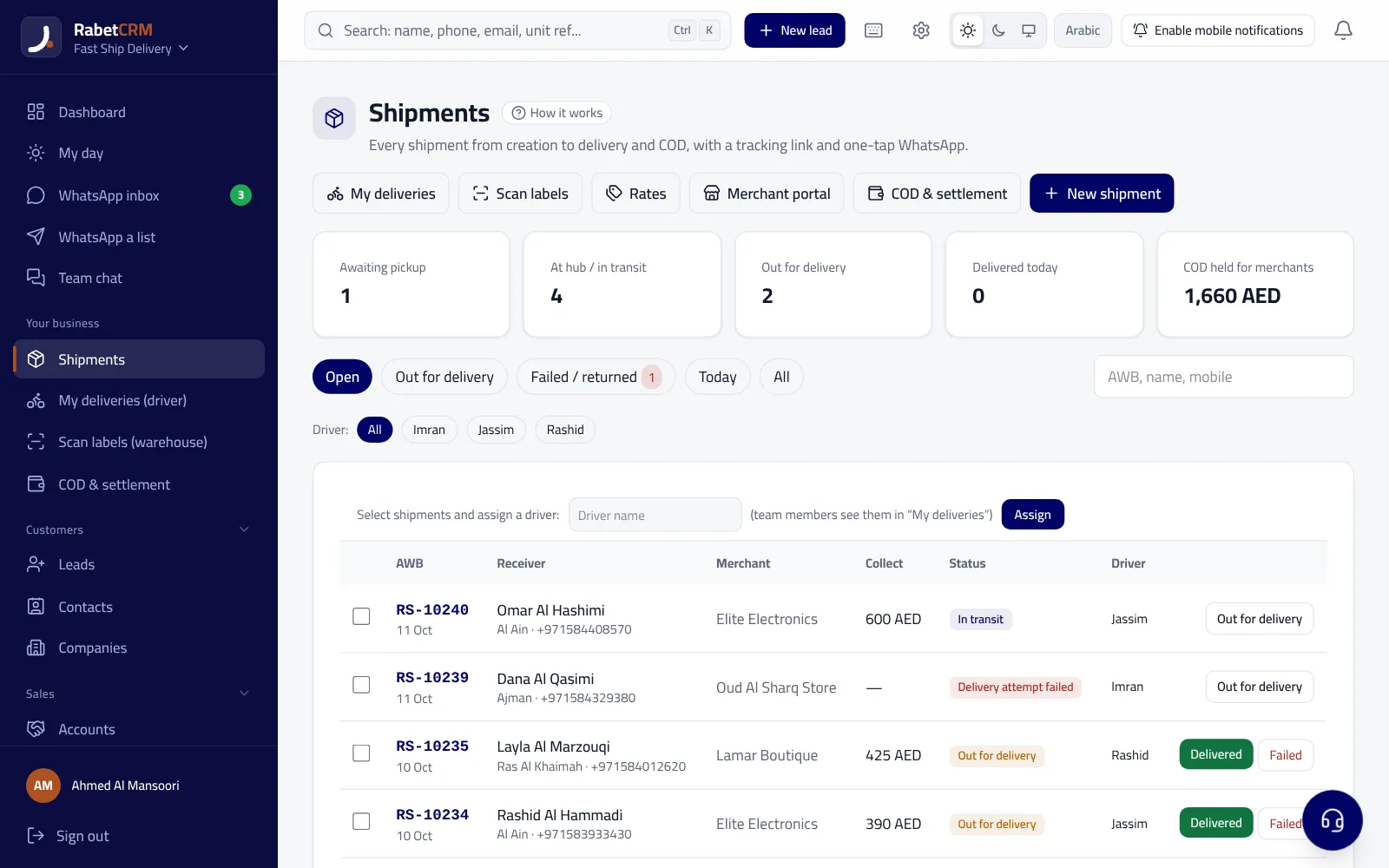
After sorting, assign shipments to drivers in bulk rather than one by one. In RabetCRM shipments are assigned to drivers in bulk and each one's status updates from pickup through delivery or return, so the operations desk always knows how many shipments each driver holds, how many are delivered and how many remain.
Set a fixed time for drivers to leave the warehouse and a cut-off for merchant drop-offs so shipments go out the same or next day. A merchant who knows that parcels handed over before a set time go out the same day can promise their customers an accurate date, which builds their trust in you. Balance loads across drivers, too: a driver carrying far too many parcels will inevitably postpone some, and a postponed shipment means a call from an annoyed receiver, a worried merchant and an extra run the next day.
| Status | Meaning | Next action |
|---|---|---|
| Picked up from merchant | The parcel is in the courier's custody | Sort and assign to a driver |
| Out for delivery | The parcel is with the driver en route | Notify the receiver with a message and tracking link |
| Delivered | Handed over and COD collected if due | Include the amount in settlement |
| Postponed | Receiver asked for another time or didn't answer | Reschedule and inform the merchant |
| Returned | Receiver refused or delivery failed for good | Return the parcel to the merchant with no COD |
Keeping receivers informed: tracking links and WhatsApp
A receiver who doesn't know when their parcel will arrive calls the merchant, the merchant calls you, and your staff call the driver — a whole chain of calls one message could replace. Better still, a receiver who knows the driver is coming has the cash ready and is available, so more parcels are delivered on the first attempt and fewer come back.
In RabetCRM every shipment has a tracking link the receiver can open without signing up, showing its movement history, and receivers get a WhatsApp message with status updates. Keep messages short: the store name, shipment number, status, COD amount if any, and the tracking link. Naming the store matters, because the receiver recognises the shop they bought from more than the courier.
Make communication two-way. A receiver who wants to change the delivery time or add better address details — a gate number or nearby landmark — should have an easy way to reply before the driver sets out. In many Gulf cities street names alone don't get you there, so asking receivers for a map pin saves drivers precious minutes at every address. Whatever the receiver adds should be recorded on the shipment itself so the driver sees it, not left in a chat they never read.
Cash-on-delivery reconciliation: driver first, then merchant
COD reconciliation happens in two stages that shouldn't be mixed up. The first is between the company and the driver: at the end of each day, the cash a driver hands in should match the total COD on shipments actually delivered. The second is between the company and the merchant: on the agreed settlement date, the merchant is owed the total collected on their shipments minus shipping fees, and sometimes return fees depending on the agreement.
The most common settlement errors: a shipment marked delivered whose cash was never handed in, a returned shipment credited to the merchant, or a COD amount changed over the phone but never updated in the system. So never allow a COD change without recording it, and make sure every shipment's status is accurate before calculating settlement.
In RabetCRM a COD amount is recorded on every shipment, and the app calculates what's been collected for each merchant after deducting shipping fees, with a per-merchant report and one-tap settlement. Send merchants a statement of delivered and returned shipments, amounts and fees with every settlement; transparent numbers are what keep merchants with you and sending more volume.
- Match each driver's cash daily against shipments actually delivered
- Never credit a merchant for a returned or postponed shipment
- Record any COD change in the system before delivery
- Agree a fixed settlement schedule and return fees with each merchant
- Send a detailed statement with every settlement
Returns and the KPIs worth tracking
Returns cost the courier a run without full revenue, and cost the merchant stock that came back and a lost sale. Track why parcels come back: no answer? Incomplete address? Refused to pay? Each has a fix: a message before arrival, asking the merchant for better addresses, or confirming the order with the buyer before shipping.
Review a handful of KPIs weekly: first-attempt delivery rate, return rate per merchant and per area, average deliveries per driver per day, and the time between delivery and merchant settlement. These numbers show where you're improving and where you're losing, and give you a strong case when pitching new merchants.
Get your delivery company organised
Start with whatever eats most of your team's time. If shipment entry is the problem, begin with bulk import and AWBs. If it's phone calls, begin with tracking links and receiver messages. If merchants complain about slow payouts, begin with recording COD on every shipment and regular settlements.
RabetCRM for courier and delivery companies brings bulk Excel shipments, QR AWBs, receiver tracking links, driver assignment and statuses, WhatsApp updates, and COD collection and merchant settlement together, in Arabic and English. Start with one user and add drivers later. Read more about choosing a CRM in the UAE, or start a 15-day free trial with no credit card.
More articles
FAQ
How do I track shipments in a small delivery company?
Give every shipment a unique AWB number and a clear status (picked up, out for delivery, delivered, postponed, returned), update it at every step, and send receivers a tracking link instead of answering calls.
How do I settle cash-on-delivery with merchants?
Match each driver's cash daily against delivered shipments, then calculate each merchant's total collected on delivered shipments minus shipping fees, and send a detailed statement on the agreed settlement date.
Can I import a merchant's shipments from Excel?
Yes. In RabetCRM for couriers you paste columns from Excel and dozens of shipments are created in seconds, each with its AWB number.
What size should a shipping label be?
100×150 mm is a common size for thermal label printers, and it's the size RabetCRM uses for its QR-coded AWB.
How can I reduce returned shipments?
Message receivers with a tracking link before arrival, ask merchants for accurate addresses and phone numbers, and track return reasons per merchant and area to fix the most frequent cause.