From inquiry to enrollment: how training institutes and course centres manage students, groups, installments and attendance
An institute enrolls more students when it answers every inquiry fast and then moves the prospect along a clear path: a placement test or trial class, the price and schedule, a seat reservation, then enrollment and payment. After enrollment comes the operational side: a group for every student with its teacher and schedule, installments with due dates and overdue reminders, and attendance records that flag students at risk of dropping out early.
Last updated:
Why don't course inquiries turn into enrollments?
Language schools, computer centres, vocational trainers and skills academies spend on Facebook, Instagram and Google ads and receive dozens of inquiries a week by WhatsApp, phone and forms. Yet many of those prospects never enroll, and the reason usually isn't price alone but weak follow-up: a late reply, a generic answer that misses the student's question, or no follow-up at all after the first message.
Choosing a course takes time: the student compares two or three institutes, thinks about schedules that fit their work or studies, and sometimes waits for a parent's or employer's approval. The institute that stays present politely during that time — with useful information and a clear start date for the next group — is the one that wins the enrollment.
The enrollment pipeline: five stages from inquiry to first class
A clear pipeline tells every receptionist or education adviser what to do with each student, and shows the manager where prospects stall. If most stop after the price, you may need a clearer installment option. If they stop before the trial class, you may need appointment reminders or more flexible slots.
- Inquiry: record name, mobile, the course wanted and the source (ad, WhatsApp, referral)
- Placement test or trial class: book a specific slot and send a reminder
- Price and schedule: the right group, start date and payment method
- Reservation: secure the seat with a first payment before the group fills
- Enrolled and paid: add the student to the group and set their installments
A follow-up cadence for prospects until they enroll
Make the first reply within minutes during working hours, with a direct answer to the student's question: is the course available, when does the next group start, is it in person or online? Then offer a small, easy next step such as booking a placement test or trial class, instead of asking for a payment decision straight away.
Then follow up on a simple schedule, with each message bringing something new rather than just "have you decided?". Avoid pushy repetition and respect anyone who asks you to stop. The table below is an example you can adapt to your course lengths and group start dates.
| Timing | Goal | Example message content |
|---|---|---|
| Within minutes | Answer and offer a small step | Next group dates and a placement test booking link |
| Next day | Remove hesitation | Course content, outcomes and who the trainer is |
| Day 3 | Address price | Installment option and what the price includes |
| Day 7 | Genuine, gentle urgency | Seats left in the group, if genuinely limited |
| Before the next group starts | A fresh opportunity | A new start date for those the last one didn't suit |
Groups and batches: who is in which group?
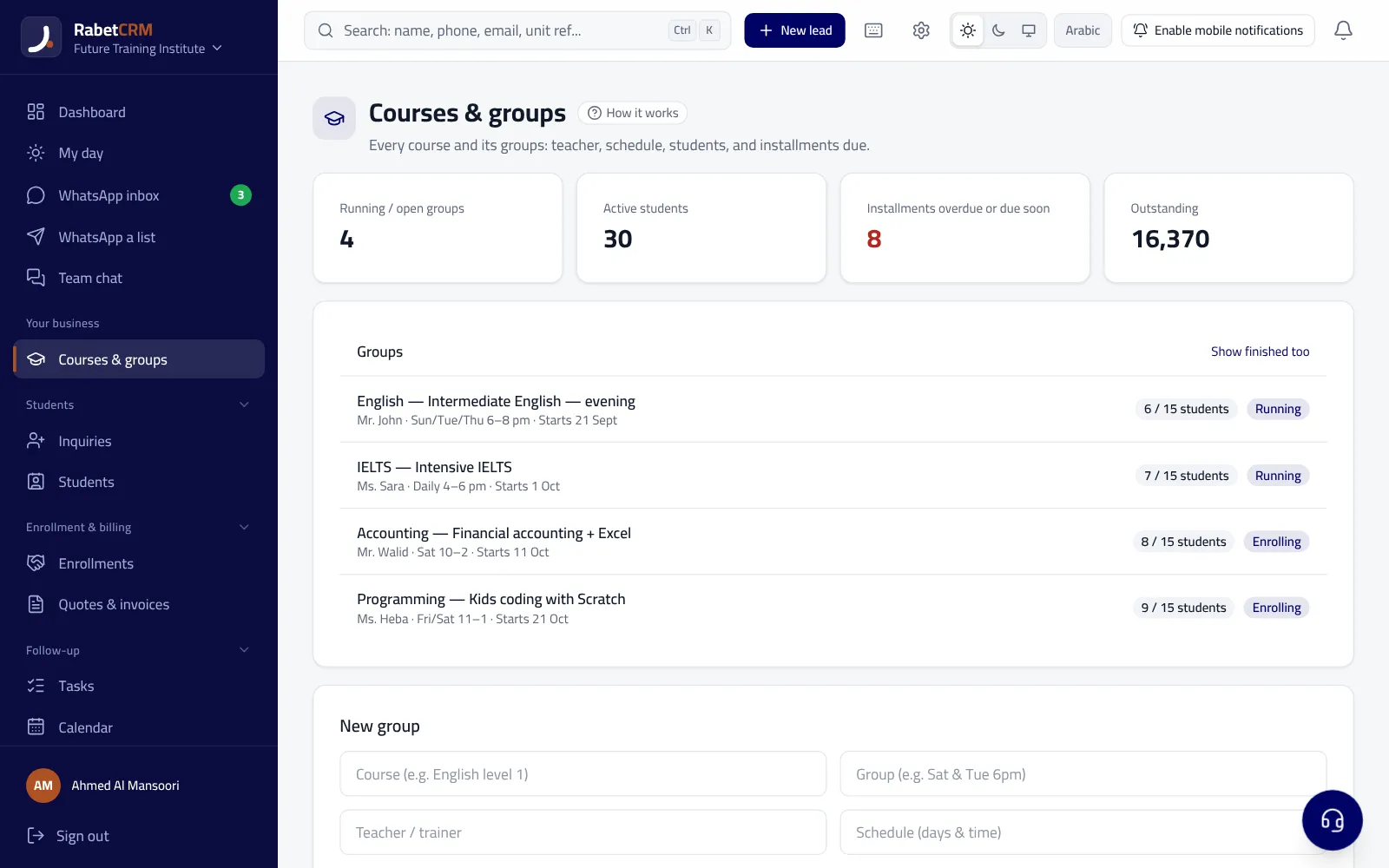
As an institute grows, "who is in which group?" becomes a daily source of confusion. The fix is for each course to have its groups, and each group a clear name (e.g. English level 1, Sat & Tue 6pm), a teacher or trainer, a schedule, a start date, a number of sessions and a maximum capacity. That shows the seats left in each group, so you never promise a seat that doesn't exist or open a new group before the current one fills.
It also helps to track each student's status in the group: active, completed or dropped. The dropout rate per group or per trainer is an important signal of teaching quality, and the list of those who completed a course is your best audience for the next level.
As a group nears its end, contact its students about two weeks before the final class to offer the next level or a follow-on course with a clear start date. A satisfied student who just finished a course is the easiest to enroll again, and costs you no ad spend. Ask them for a referral or a genuine review too — referrals are one of the strongest sources of new students for institutes.
Installments: collecting without embarrassing the student
Installments raise enrollment by lightening the first payment, but they need organised follow-up or balances turn into forgotten debts. Record each student's total price, amount paid, balance, number of installments and next due date, and review a daily list of installments that are overdue or due soon.
Agree the number and dates of installments with the student in writing from the start, and give an invoice or receipt for every payment. It's best to tie installment dates to course milestones, such as the start of each month or level, so the student feels they pay for what they actually receive. Check with your accountant or the Federal Tax Authority whether VAT applies to your course fees, and show it clearly on the invoice if it does.
A polite reminder a few days before an installment is due works far better than chasing after it. Send a short message with the amount and date, offer the available payment methods, and never discuss arrears in front of other students. If delays repeat, contact the student or their parent privately to agree a workable schedule.
Attendance: an early warning for dropouts
Taking attendance isn't just admin; it's the best early indicator of a student about to drop out. A student who misses two or three classes in a row usually has a problem: a schedule that doesn't fit, a level that's too hard, or work pressure. Calling them at that point often solves it, by moving them to another group or offering a make-up session.
Make attendance quick enough that it takes a teacher no more than a minute: tick who attended and the rest are marked absent. Then review students with repeated absences weekly. Some bodies or certificates require a minimum attendance rate, so state your attendance policy in the enrollment terms from the start.
Certificates and licensing: what to know
The certificate at the end of a course is part of what the student is buying, so tie its issue to clear conditions announced up front — such as completing the course, a minimum attendance and paying the fees — and keep a record of who qualified and who collected it. If the course prepares for an international certificate awarded by an outside body, make clear that the exam and certificate come from that body, on its terms.
Licensing differs between emirates and countries. In Dubai, for example, private training institutes are supervised by the Knowledge and Human Development Authority (KHDA) under Executive Council Resolution No. 50 of 2015 regulating training institutes in the Emirate of Dubai, and need an educational permit from KHDA alongside the trade licence. In other emirates and Gulf countries the competent authority and requirements differ, so confirm them directly with the education authority in your emirate or country before advertising any course or certificate.
Metrics an institute manager should review monthly
Feeling that a month was good or bad isn't enough; a few simple numbers tell you where to act. You don't need a complex reporting system, just data recorded consistently from the first inquiry to the last class. If you learn, for example, that referred students enroll at a higher rate than ad leads, you can reward students who refer friends and revisit your ad messaging.
Start with the metrics below and compare them month to month rather than against other institutes, since every institute differs in courses, audience and pricing. More important than the number itself is asking after each review: what one thing will we change next month? It might be a faster first reply, an evening group, or a different installment option.
- New inquiries and the source of each
- Share of inquiries who attended a placement test or trial class
- Enrollment rate from trial classes
- Average time from inquiry to enrollment
- Each group's fill rate against capacity
- Overdue balances and dropout rate per group
How RabetCRM helps you manage students and groups
In RabetCRM for institutes and training centres every inquiry from Facebook/Instagram lead ads and WhatsApp lands in one place and moves through a clear enrollment pipeline: inquiry, placement test or trial class, price and schedule, reservation, then enrolled and paid. Students can book a placement test or trial class themselves through your branded online booking page, with a WhatsApp reminder, and you can store a parent's phone and the student's grade when needed.
After enrollment, each course has its groups with teacher, schedule, start date, number of sessions and capacity, and each student has a status (active, completed, dropped), amount paid, balance and next installment date, with a list of overdue or upcoming installments, WhatsApp reminders and an invoice link for the student. Teachers take attendance by ticking who attended, and a student with 3 absences shows in red so you can reach out early. Learn more on the institute software page, or start a 15-day free trial with no card.
More articles
FAQ
How can I turn more course inquiries into enrollments?
Reply within minutes with a direct answer, offer a small step such as a placement test or trial class, then follow up on a clear schedule where each message adds something new, and offer a clear installment option.
How do I keep track of student installments?
Record each student's total, paid amount, balance and next due date, review a daily list of overdue or upcoming installments, and send a polite reminder a few days before the due date.
Do training institutes in Dubai need KHDA approval?
Yes — private training institutes in Dubai are supervised by KHDA under Executive Council Resolution No. 50 of 2015, with specific exemptions in the resolution. Confirm your current requirements directly with KHDA.
Why record attendance on courses?
Because repeated absences are the best early warning of dropouts, and some certificates require a minimum attendance. Reaching out after two or three absences often fixes the issue before the student leaves.
Is there Arabic software for running a training institute?
Yes — RabetCRM has an Arabic and English interface, follows inquiries through to enrollment, and manages groups, installments and attendance, with an online booking page and a 15-day free trial.