Rental yield in Dubai: how to calculate it properly before advising an investor
Gross rental yield in Dubai = annual rent ÷ purchase price × 100. Net yield deducts annual service charges, maintenance, vacancy and management fees from the rent, and adds the Dubai Land Department fee (4%), registration fees and the agent's commission to the purchase price. The gap between the two can reach two or three percentage points — the difference between a satisfied investor and one who feels misled. A professional broker shows both figures and relies on the official rental index, not portal listings alone.
Last updated:
Gross vs net yield
Gross yield is simple and common in ads because it produces a higher number: just divide expected annual rent by the purchase price. But it ignores everything the landlord actually pays: annual service charges to the owners' association, maintenance, the months the unit sits empty between tenants, and management fees if any. It also ignores that the true acquisition cost is higher than the listed price.
Net yield is the number investors care about. Subtract annual expenses from rent, then divide by the total acquisition cost. That figure allows a fair comparison between an apartment in a tower with high service charges and a villa in a community with lower ones, or between a ready unit and an off-plan unit.
| Item | In gross yield | In net yield |
|---|---|---|
| Annual rent | Included in full | After vacancy allowance |
| Service charges | No | Deducted |
| Maintenance & management | No | Deducted |
| 4% DLD fee & registration | No | Added to acquisition cost |
| Agent commission | No | Added to acquisition cost |
A simplified worked example
The figures below are illustrative only, to explain the method, not prices for a specific area. An apartment costs AED 1,000,000 with expected rent of AED 75,000 a year. Gross yield = 75,000 ÷ 1,000,000 = 7.5%. Now add to the acquisition cost the 4% DLD fee (AED 40,000), a 2% agent commission (AED 20,000) and roughly AED 5,000 in registration fees, for a total cost of AED 1,065,000.
On the expense side: AED 12,000 in annual service charges, AED 3,000 maintenance, and one vacant month a year (AED 6,250). Net rent = 75,000 − 12,000 − 3,000 − 6,250 = AED 53,750. Net yield = 53,750 ÷ 1,065,000 ≈ 5%. That's a gap of about two and a half points, which the investor should know before signing.
Where to get reliable inputs
The biggest mistake is estimating rent from the highest portal ad. An ad is an asking price, not a contract price. It's more accurate to rely on the Dubai Land Department's official rental index, and on recently registered contracts in the same building or community where available to you. Service charges also have an official index showing the rate per project, so don't rely on the seller's estimate.
- Rent: the official rental index + recent contracts in the same building
- Service charges: the official service charge index for the project
- Vacancy: one month a year as a conservative assumption for residential units
- Maintenance: a small share of rent, higher for villas and older units
- Short-term lets: account for management, permit and furnishing costs separately
Yield on off-plan units
Off-plan units produce no rent until handover, and the investor pays in installments. So show two scenarios: expected yield after handover on the full price, and the return on the amount actually paid by handover if the plan includes post-handover payments. Make clear that rent two or three years out is an estimate, not a promise, because the market moves. An investor who understands the assumptions trusts the broker more than one who hears a single shiny number.
Future years and rent-increase rules
Many brokers calculate year-one yield and then assume rent rises by a fixed rate every year. In Dubai, increasing rent on a sitting tenant isn't free-form: it's tied to the gap between the current rent and the average market rent in the rental index, and it requires advance notice to the tenant before the contract ends, within a period set by law. So if a unit is let below market, reaching market rent may take more than a year.
When showing three- or five-year projections, present a conservative scenario that assumes no increases and another that uses the allowed increase under the index. Use the Dubai rent increase calculator to find the permitted ceiling before promising any figure. An investor who sees the worst case and accepts it won't call you angry a year later.
How to present the numbers to an investor
The best presentation is a single page or a single clear message: unit price, total acquisition cost itemized, expected rent and its source, annual expenses, then gross and net yield side by side. Add a line stating clearly that the figures are estimates based on data as of a given date. This makes comparing three units easy and saves weeks of repeated questions.
- Unit price + DLD fee + commission + registration = total cost
- Expected rent with its source and date
- Service charges, maintenance and vacancy as annual figures
- Gross and net yield on one line
How a CRM helps you advise investors
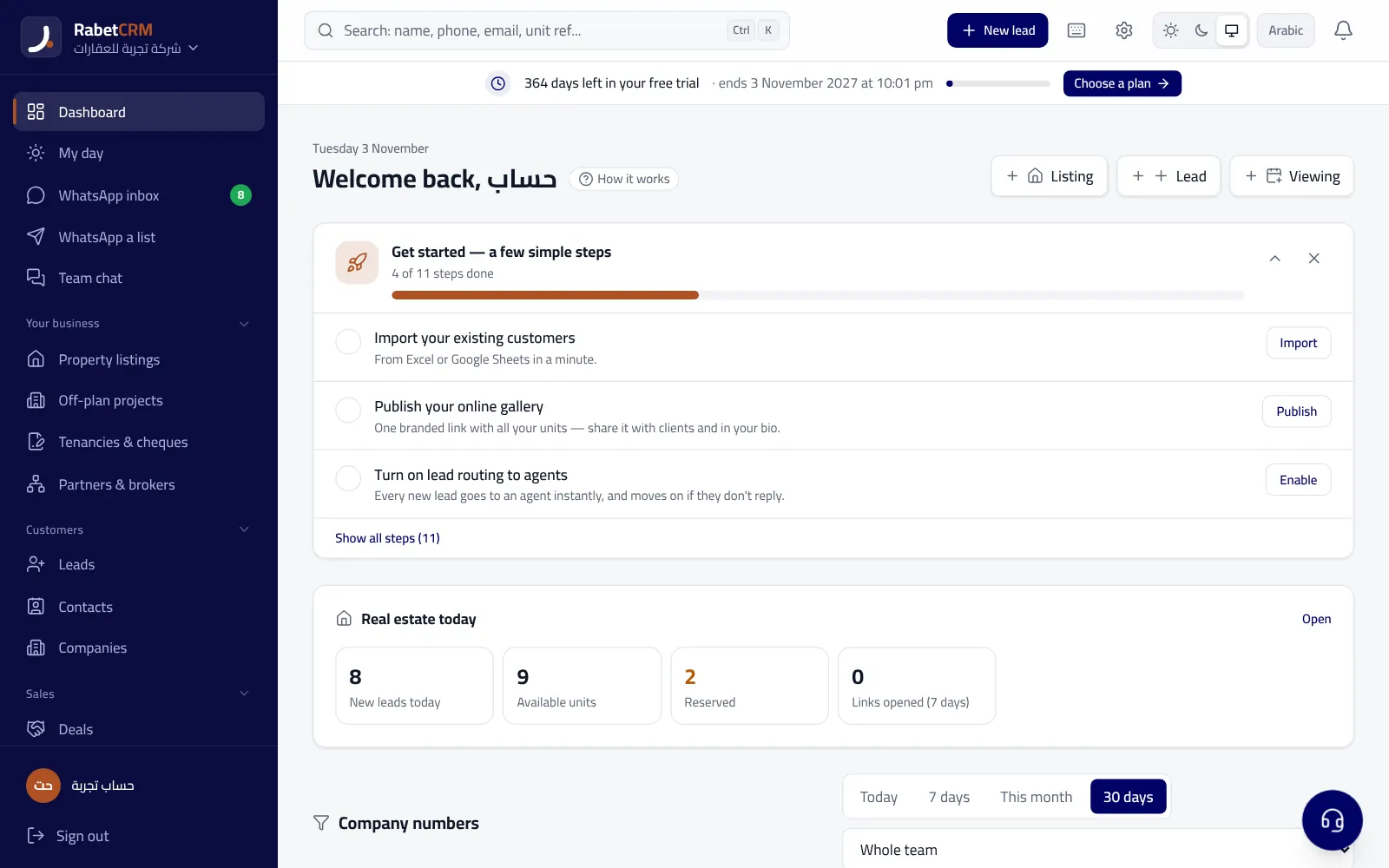
Investors usually compare several units and come back weeks later with a new question. When units are recorded in the system with price, service charges and expected rent, you can send a quick comparison on WhatsApp, log their notes on their record, and know when to follow up. In RabetCRM you can record units and match them to client requests, follow up investors with tasks and reminders, and use the rental yield calculator and buying costs calculator before sending.
Common mistakes to avoid
These mistakes recur in brokers' messages to investors, and each can cost you credibility. Stay transparent: a lower honest number builds a longer relationship than a higher one that proves wrong a year later.
- Showing gross yield only without saying it's gross
- Using ad prices instead of contract rents
- Forgetting DLD fees and commission in the acquisition cost
- Assuming 100% occupancy all year
- Ignoring rent-increase rules when projecting future years
More articles
Real estate CRM in every emirate
Compare RabetCRM
FAQ
What's the difference between gross and net yield?
Gross divides rent by price only. Net deducts annual expenses from rent and adds purchase fees to the cost, giving a more realistic picture.
Where do I find real rents for an area?
From the Dubai Land Department's official rental index and recently registered contracts in the same building — not ad prices alone.
Do short-term lets always yield more?
Not always. Revenue may be higher, but so are costs: management, furnishing, permits and variable vacancy. Compare net figures.
Should I quote yields per area to investors?
Quote figures for a specific unit from recent sources and say they're estimates. Area-wide figures change every quarter.
Is there a ready calculator?
Yes, the free rental yield calculator works out gross and net yield once you enter rent and expenses.
Are service charges fixed every year?
No, they're approved annually per project and can go up or down. Check the official index for that project and assume a modest rise in multi-year projections.