The new real estate agent in Dubai: a 90-day plan from choosing your area to closing your first deal
A new Dubai agent's first 90 days split into three phases: a month to set up (your card, one focus area, learning prices and buildings, and a system to hold your leads), a month to build a pipeline (units under listing agreements, permitted ads, fast replies to every enquiry), and a month to convert (regular viewings, disciplined daily follow-up and your first closed deal). The secret isn't hours worked — it's a fixed daily routine and a database where no lead ever gets lost.
Last updated:
Before day one: what must be in place?
Don't start real client work before your broker card is valid: without it you can't sign Land Department forms or advertise any unit under the office's name. We covered the training, exam and documents in how to register as a broker in Dubai. Use the wait for the card to learn, not to wait.
In week one, ask your manager three things clearly: how portal leads are distributed, how commission is split between you and the office, and which tools you get (portal access, a CRM, the office WhatsApp number). The answers shape your time — an agent who receives leads from the office has a very different day from one who must generate their own.
How do you pick your focus area in Dubai?
The biggest new-agent mistake is trying to cover all of Dubai. The market is large and varied, and clients trust the agent who knows the building, the street and the real prices — not the one who sends links from everywhere. Pick one main area (or one large community) and a nearby secondary one, and commit to them for at least 90 days.
The criteria are practical: does the office have units or owners there? Is there steady sales and leasing activity? Can you reach it quickly for viewings? And does the typical client there suit your languages and network? Use the official transaction data available from the Land Department to gauge activity rather than relying on impressions.
Once you've chosen, turn your area knowledge into a written file: the main buildings or communities, rent and sale ranges per unit type, developers, nearby schools, transport and malls, and common client questions with answers. This file is what lets you answer confidently on the first call, and it saves time writing ads and messages. Update it every two weeks with the new prices you see in deals and listings.
| Criterion | Question to ask yourself | Why it matters |
|---|---|---|
| Office support | Does the office have owners or units here? | Your first units will likely come from the office |
| Activity level | Are there regular sales and lettings? | A slow area means a long wait for deal one |
| Distance | Can I reach viewings quickly? | Frequent viewings need easy travel |
| Client profile | Do my languages and network fit clients here? | Trust builds faster with people you understand |
| Competition | How many agents advertise here? | A crowded area needs sharper service |
The 90-day plan, week by week
This plan is a framework, not a law. You may close a rental in week five, or a sale may take longer than 90 days — both are normal. What matters is knowing each week's goal and measuring your activity (calls, messages, viewings), not just results.
| Period | Goal | Key tasks |
|---|---|---|
| Weeks 1–2 | Set-up | Card, office processes, pick your area, set up your CRM account |
| Weeks 3–4 | Know the area | Visit buildings, collect real prices, learn developers and communities, write an area summary |
| Weeks 5–6 | First units | Contact owners, sign first listing agreements (Form A), get permits and publish ads |
| Weeks 7–8 | Pipeline | Fast replies to every enquiry, qualify leads, book first viewings |
| Weeks 9–10 | Viewings and offers | Regular viewings, follow up within 24 hours of each, first offers |
| Weeks 11–13 | Close and review | Negotiate and close deal one, review your numbers, adjust the plan for next quarter |
Portals and listings: starting the right way
In Dubai a large share of enquiries come through portals such as Property Finder, Bayut and Dubizzle. The portal account usually belongs to the office, and your manager decides how many listings you get. So don't post a lot — post well: real, clear photos, an accurate description, a realistic price and a correct Trakheesi permit number on every ad. We compare the portals from a broker's point of view in Bayut vs Property Finder vs Dubizzle.
Never publish a unit without a valid listing agreement with the owner and an advertising permit — portals reject non-compliant ads, and a violation hurts your reputation before you've started. Details in our Trakheesi and Madhmoun guide.
- Shoot the unit yourself in daylight; never reuse photos from other ads.
- Write the description in Arabic and English, leading with the top three features.
- Update the status as soon as the unit is sold or let, and pull the ad.
- Save the listing reference on every lead so you know which ads pull enquiries.
How do you build a client database from scratch?
Your database is your real capital — it's what stays with you after every deal. From day one, log everyone you speak to: name, mobile, source, what they want (buy or rent, area, budget, bedrooms, move date), last contact and next step. A client who lives only in your memory or a WhatsApp chat is a lost client two weeks later.
Early sources: portal leads the office routes to you, unit owners in your area, tenants whose leases are ending soon, your personal network (as long as contact is professional and respectful), and referrals from every client you serve well. If you have older numbers in Excel or your contacts, import them once into the system with duplicate prevention.
- Record every lead's source from day one — you'll need it to see what brings deals.
- Every lead needs a dated next step, or it's a forgotten lead.
- Tag buyers, tenants and owners separately.
- Don't send bulk messages to people who haven't opted in.
The daily follow-up routine that makes deals
Agents who succeed in year one aren't necessarily the most talented — they're the most disciplined. Clients usually contact several agents, and the first useful reply usually wins. So make replying to new enquiries your absolute priority, and protect a fixed daily slot for follow-up.
Measure your activity weekly with simple numbers: calls, useful messages, viewings, and leads who moved a stage forward. These are fully in your control, while deals are a result that sometimes lags.
Follow-up doesn't mean "are you still interested?" every two days. Each message should carry value: a new unit in budget, a price change, or a useful area insight. Ready-made templates save a lot of time — see examples in our real estate WhatsApp follow-up guide.
| Time | Activity | Aim |
|---|---|---|
| First hour | Review new enquiries and today's tasks in the CRM | No enquiry left unanswered |
| Morning | Two hours of calls and follow-up with current leads | Move leads toward viewings |
| Midday | Viewings and building visits | At least one viewing a day when leads allow |
| Afternoon | Owner outreach, update units and ads | New units and accurate ads |
| End of day | Log notes and set the next step for each lead | Tomorrow is planned before it starts |
The road to your first deal: what to expect
A rental deal is usually faster than a sale, so many new agents start with leasing to build confidence, experience and income, then grow into sales. When you reach a serious offer, explain the full costs to the client, not just the price: registration fees, commission and any financing costs. Use the property buying costs calculator to give the client a clear number, and work out your net commission before negotiating any discount.
At the end of 90 days, review your numbers honestly: how many enquiries came in? How many did you answer within minutes? How many viewings, how many offers? Which source did each serious lead come from? These numbers show where the gap is: too few leads, slow replies, or weak conversion from viewing to offer.
Don't forget what comes after the deal: ask a happy client for a review or referral, and log the lease end date or handover date so you reach out before it. Today's tenant may be tomorrow's buyer, and the landlord you just let a unit for may hand you their second one. Agents who build long relationships need far less spend to find clients in year two.
Tools that shorten the road
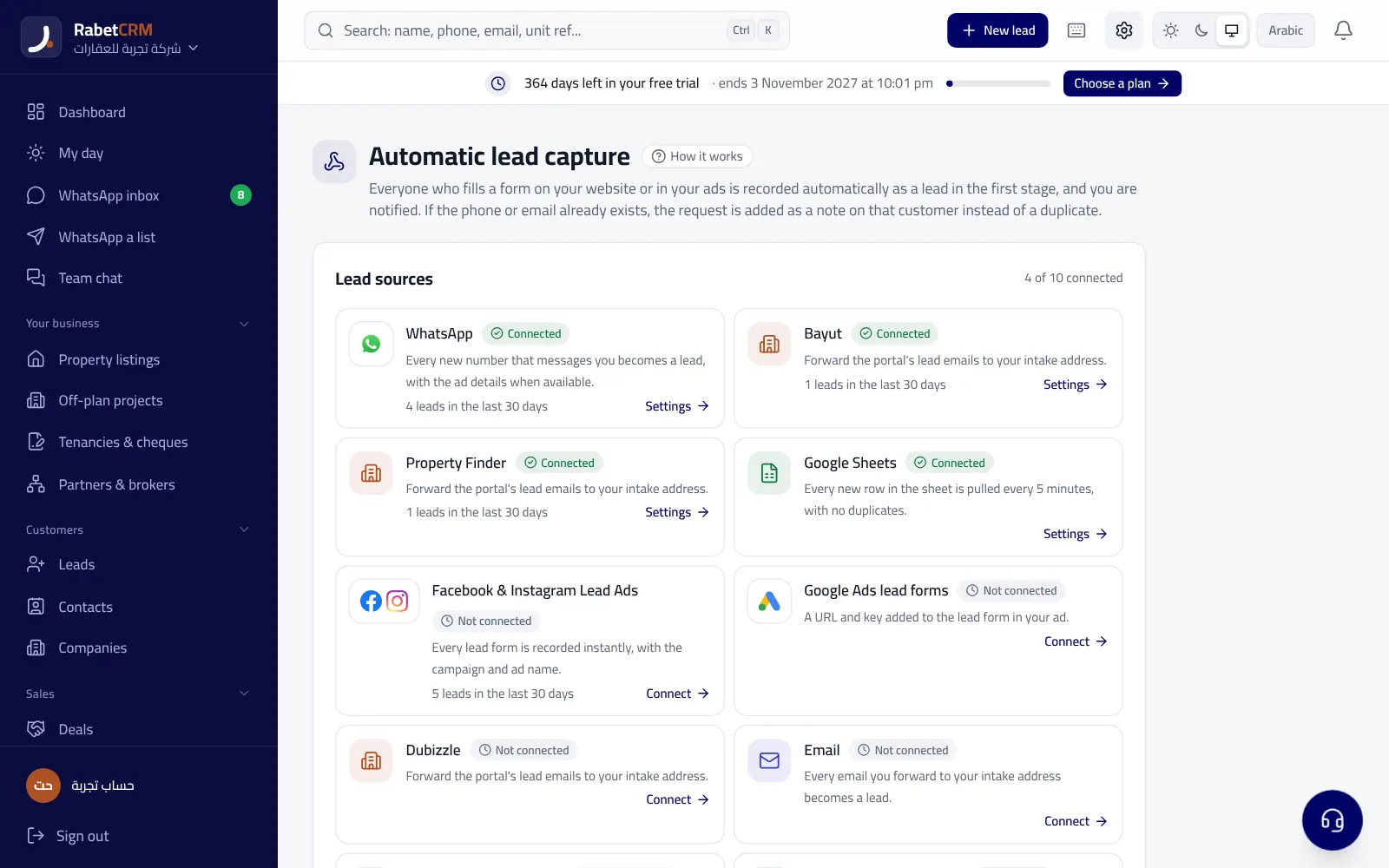
In RabetCRM for real estate, Bayut, Property Finder and Dubizzle enquiries arrive automatically as leads with the listing reference, WhatsApp messages land in a shared inbox, and every lead gets a 0–100 hotness score from real engagement (replies, opened listing links, upcoming appointments), so you know who to call first. It also matches leads to suitable units, keeps tasks and appointments, and shows you and your manager response time, deals and commissions.
If your office doesn't use a system yet, suggest a 15-day free trial to your manager — no credit card — and run the plan above on your real leads.
More articles
Real estate CRM in every emirate
Compare RabetCRM
FAQ
How long does a new Dubai agent take to close a first deal?
There's no fixed number; it depends on the area, deal type, office support and your daily activity. Rentals are usually faster than sales, so many new agents start there.
Should I specialise in one area or cover all of Dubai?
Start with one main area and one nearby secondary area. Specialising means you know prices and buildings precisely, so clients and owners trust you faster.
Should I start with rentals or sales?
Many agents start with rentals because they move faster and build experience and income, then expand into sales. Either way, master your area.
How do I build a client base as a newcomer in Dubai?
From portal leads the office routes to you, unit owners in your area and referrals — logging every lead, its source and next step in one system from day one.
Do I need a RERA card before dealing with clients?
Yes. You can't sign Land Department forms or advertise units until your broker card is valid. Steps in registering as a broker in Dubai.