Tracking down payments and quarterly installments for compound buyers in Egypt: a practical guide with a worked example
Most off-plan compound units in Egypt are sold with a down payment followed by quarterly installments over several years: a EGP 5,000,000 unit with 10% down and 28 quarterly installments means a EGP 500,000 down payment and then EGP 160,714.29 every three months for seven years. Tracking these dates by hand in Excel gets hard across dozens of clients, while a CRM such as RabetCRM generates the installment schedule automatically from the payment plan and reminds you before each one.
Last updated:
How do compound payment plans work in Egypt?
In off-plan sales, an Egyptian developer usually offers more than one payment plan for the same project: a down payment as a percentage of the unit price, then equal installments over a number of years, paid monthly, quarterly or semi-annually. Quarterly installments (every three months) are among the most common formats, because they mean fewer payments for the buyer and a steady flow for the developer.
A plan may include extra payments, such as an amount due at handover, a maintenance deposit due before handover, or annual payments larger than the regular installments. These details vary by developer and by project, and the final reference is always the developer's contract, so the payment plan should be recorded exactly as it is in the contract, not as the salesperson remembers it.
Worked example: EGP 5M unit, 10% down and 28 quarterly installments
Take an illustrative unit priced at EGP 5,000,000, with a payment plan of 10% down and the rest over 28 equal quarterly installments (seven years). The figures are for illustration only, not the price of a specific project, and the same calculation applies to any price or percentage.
Down payment = 5,000,000 × 10% = EGP 500,000. Remaining = 5,000,000 − 500,000 = EGP 4,500,000. Quarterly installment = 4,500,000 ÷ 28 ≈ EGP 160,714.29. Because the division doesn't come out even, the rounding difference is usually absorbed in the last installment, making it EGP 160,714.17, so the installments total exactly EGP 4,500,000.
| Item | Calculation | Amount (EGP) |
|---|---|---|
| Unit price | — | 5,000,000 |
| Down payment (10%) | 5,000,000 × 10% | 500,000 |
| Remaining after down payment | 5,000,000 − 500,000 | 4,500,000 |
| Number of installments | 4 per year × 7 years | 28 |
| Quarterly installment | 4,500,000 ÷ 28 | 160,714.29 |
| Total paid per year | 160,714.29 × 4 | 642,857.16 |
| Last installment (after rounding adjustment) | 4,500,000 − (27 × 160,714.29) | 160,714.17 |
What the schedule looks like: an extract from the example
Assuming the first installment falls due three months after signing, the schedule for the example above looks like this. Notice that what the buyer pays by the end of the first year exceeds one million pounds — something they should know before signing, not after. Some developers set a different first due date, so always follow the contract.
| Payment | Due | Amount (EGP) | Cumulative paid (EGP) |
|---|---|---|---|
| Down payment | At signing | 500,000.00 | 500,000.00 |
| Installment 1 | After 3 months | 160,714.29 | 660,714.29 |
| Installment 2 | After 6 months | 160,714.29 | 821,428.58 |
| Installment 3 | After 9 months | 160,714.29 | 982,142.87 |
| Installment 4 | After 12 months | 160,714.29 | 1,142,857.16 |
| ... | ... | ... | ... |
| Installment 27 | After 81 months | 160,714.29 | 4,839,285.83 |
| Installment 28 (last) | After 84 months | 160,714.17 | 5,000,000.00 |
Why is tracking installments in Excel hard?
One schedule for one client is easy. But a brokerage, or an investor managing dozens of units with different developers, faces hundreds of due dates under different plans: one with 5% down, another with 15%; one over eight years, another over six; one with a handover payment. With the first rescheduled date or broken formula, the file loses its credibility.
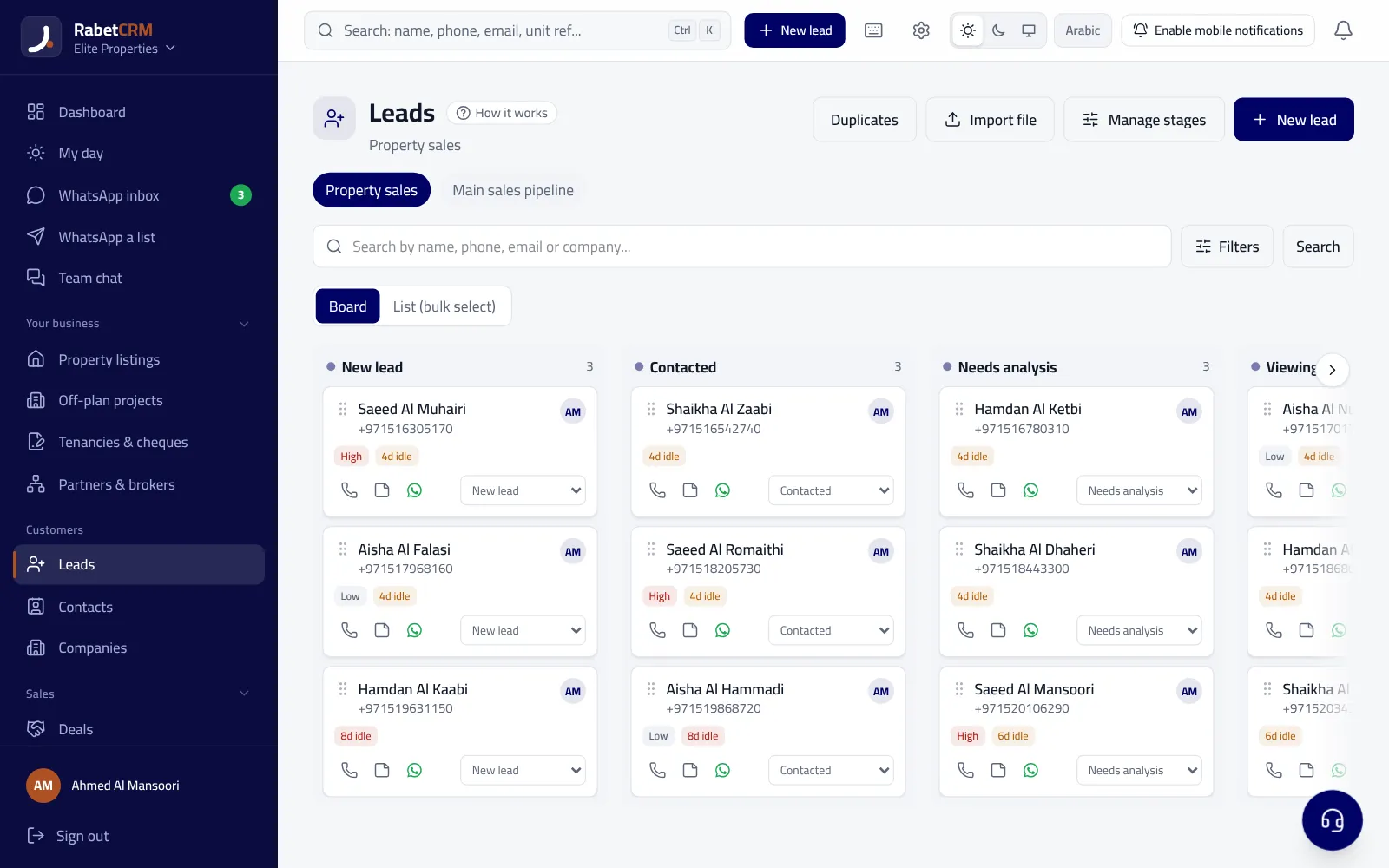
The bigger problem is that Excel doesn't remind anyone. It won't alert you before an installment is due, won't link the installment to the client's file and chats, and won't show the manager who has fallen behind. That's why many companies move to a system that keeps the client, the unit and the payment plan in one place; there's a wider comparison in Excel vs CRM for real estate in Egypt.
How RabetCRM tracks down payments and installments
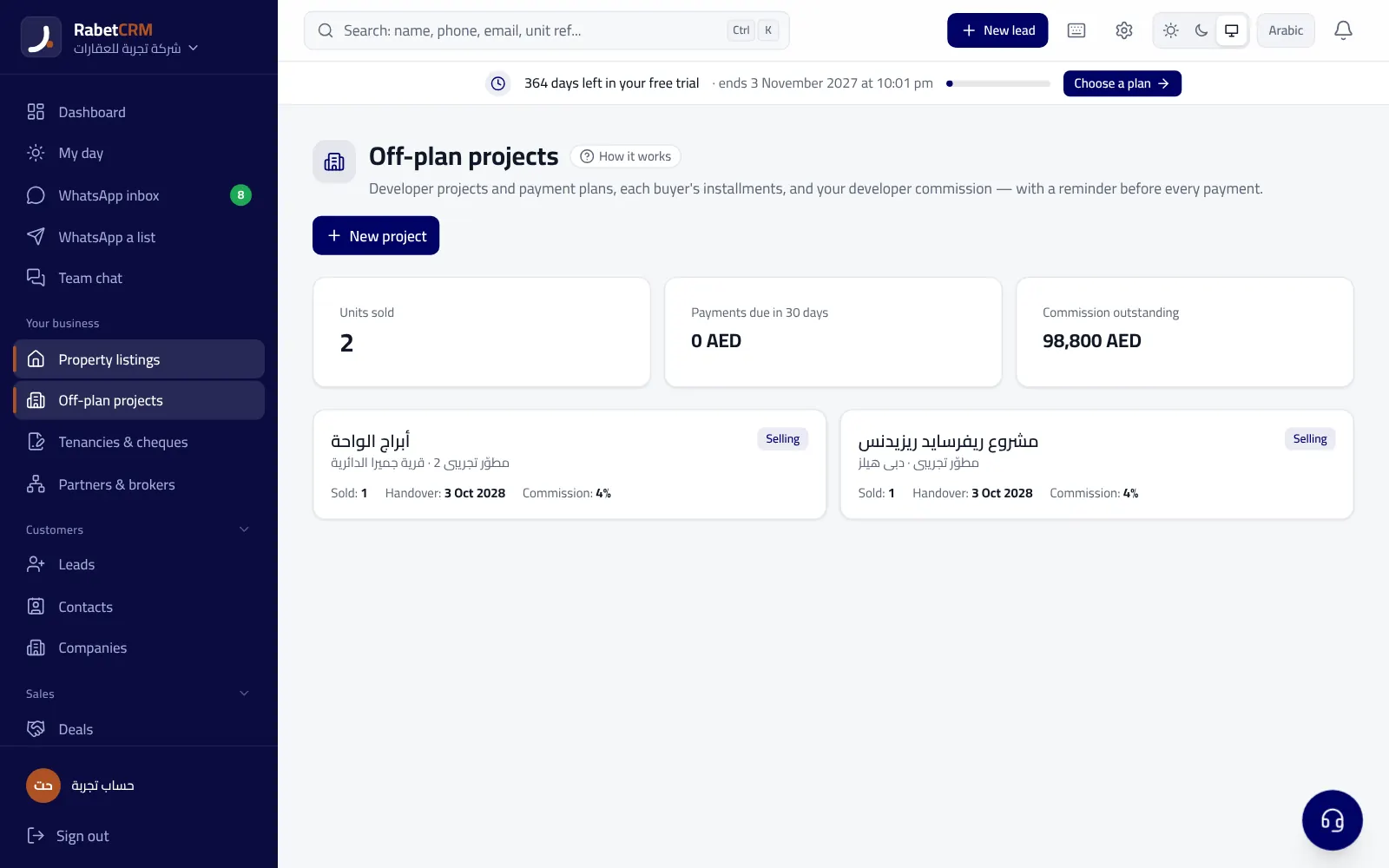
In RabetCRM you record developers' off-plan projects with each project's payment plans, such as 10% down and 28 quarterly installments. When a deal closes on a unit in the project, the app generates the buyer's installment schedule automatically from the price, down payment, number of installments and their frequency, in Egyptian pounds, with reminders before each installment is due.
Because the schedule is linked to the client's file, the salesperson can send a friendly reminder over WhatsApp from inside the system using a ready template, and the chat stays logged. The manager sees upcoming and overdue installments for all clients, while each salesperson sees only their own clients according to permissions.
- Multiple payment plans per project: down payment %, number and frequency of installments
- Installment schedule generated automatically when the deal closes
- Reminders before each installment and tracking of paid vs remaining
- WhatsApp reminder messages from ready templates
- Deal linked to the developer's commission, with reports in EGP
Good practice before and after signing
Installment tracking doesn't start after signing — it starts on the first call. Ask the client what down payment they have and what they can pay every three months, and recommend projects that fit both numbers. A buyer who struggles to pay a year later remembers who sold them the unit; one who bought on a comfortable plan comes back with referrals.
- Send the full schedule before signing, including the first-year total
- Make extra payments clear, such as maintenance deposit or handover payment, if any
- Record the plan as in the developer's contract and check it against the signed copy
- Contact the client before the due date, not after they're late
- Keep clients' financial data confidential in line with Personal Data Protection Law No. 151 of 2020
Start with one project
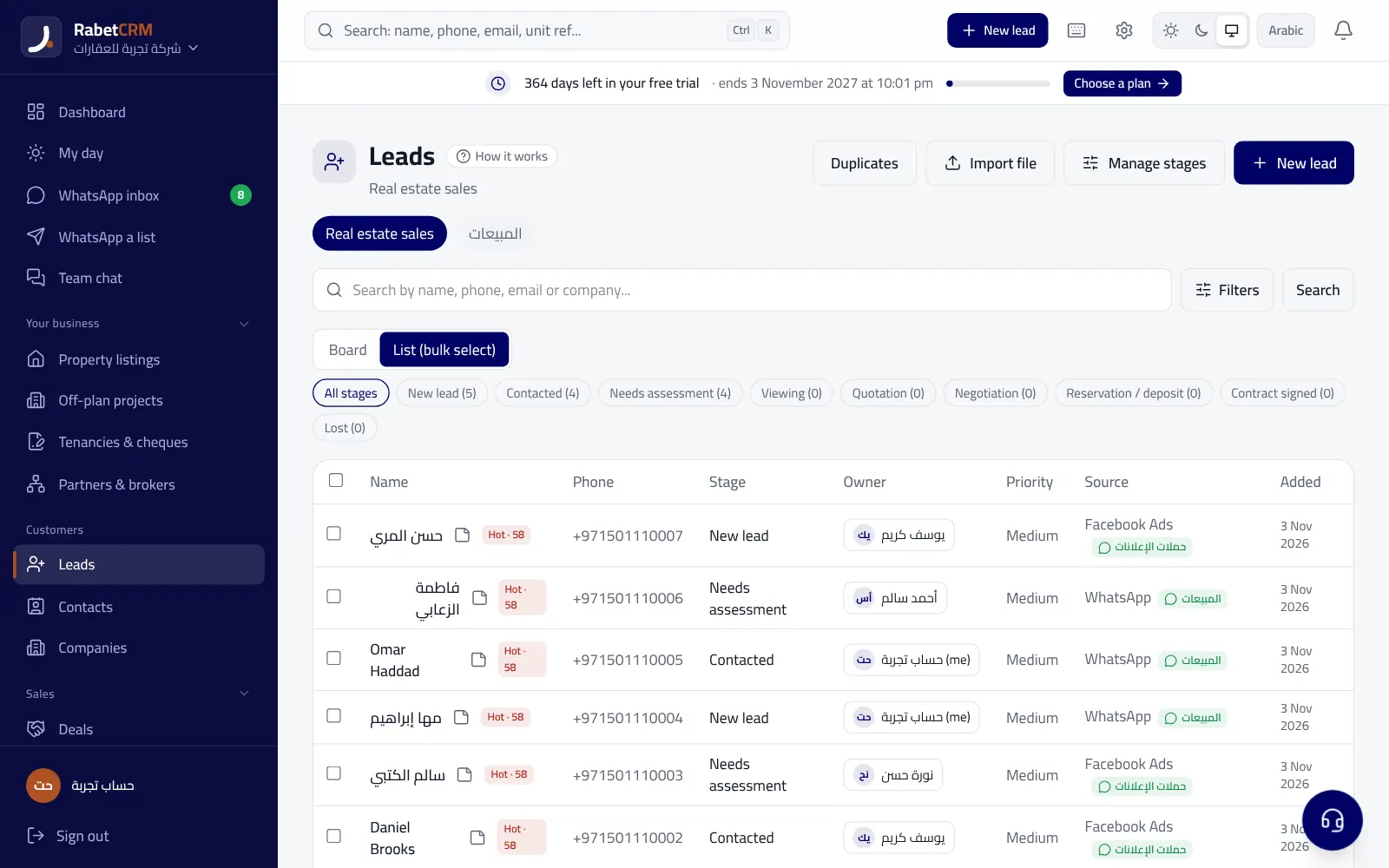
The easiest way to start: enter one project you're selling now with its payment plan, record the existing deals on it, and watch how installments and reminders appear. Then add the other projects gradually. For the full picture of running a property company in Egypt, see the guide to real estate CRM in Egypt.
RabetCRM runs in Arabic and English and in Egyptian pounds, with a ready setup for real estate companies. Learn about RabetCRM in Egypt, compare options in the guide to the best CRM in Egypt, or start your free trial.
More articles
Real estate CRM across Egypt
FAQ
How do I calculate the quarterly installment on a compound unit?
Subtract the down payment from the unit price, then divide the remainder by the number of installments (years × 4). Example: a EGP 5,000,000 unit with 10% down over 28 installments: (5,000,000 − 500,000) ÷ 28 ≈ EGP 160,714.29.
How many years are 28 quarterly installments?
Seven years, since a year has four quarterly installments.
Why is the last installment slightly different?
Because dividing the remainder by the number of installments may not come out even, each installment is rounded to the nearest piastre and the difference is adjusted in the last one so the total matches exactly. The final reference is the developer's schedule in the contract.
Does RabetCRM generate the installment schedule automatically?
Yes. You record the project with its payment plan (such as 10% down and 28 quarterly installments), and when the deal closes the app generates the buyer's schedule with reminders before each installment.
Can I remind the client about an installment on WhatsApp?
Yes. From the WhatsApp inbox inside RabetCRM you can send a reminder from a ready template, and the chat stays logged on the client's file.