Getting Real Estate Agents to Actually Use the CRM: A 30-Day Rollout Plan
· 3 min read · RabetCRM team
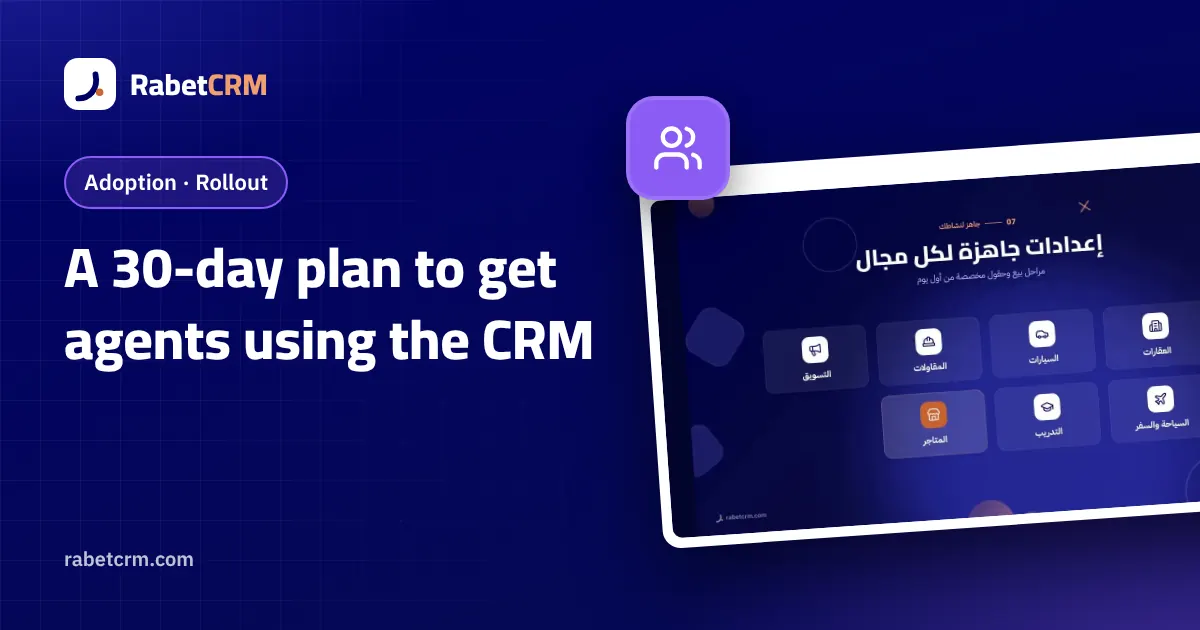
Real estate CRM adoption is where most rollouts fail — not at purchase, but in the weeks after. This 30-day plan focuses on making the CRM useful to agents first, so daily use follows naturally.
Agents don't resist CRMs because they dislike software. They resist because a CRM feels like admin that helps the manager, not them. A rollout succeeds when, by week two, agents notice the CRM is bringing them leads faster and reminding them of deals they would have forgotten.
Week 1: Leads in, nothing else
- Import existing clients and connect lead sources — ads, website form, WhatsApp.
- Turn on routing so new leads appear on agents' phones instantly.
- Make only three fields mandatory: name, phone, source.
- Agree one rule: if it isn't in the CRM, it doesn't count for commission.
Week 2: Pipeline and outcomes
- Walk through the stages and write a one-line definition for each.
- Ask agents to log every call outcome — it takes one tap.
- Run the first Sunday pipeline review using the board, not a WhatsApp group.
Week 3: Follow-ups and listings
- Every open lead gets one dated follow-up task.
- Add live listings so agents can send matched units from the lead's page.
- Save quick replies for the questions agents answer twenty times a day.
Week 4: Reports and recognition
- Share response time and deals per agent in the team meeting.
- Recognise the agent with the best follow-up discipline, not only the top closer.
- Switch on automations for the stage changes that create the most manual tasks.
Measuring real estate CRM adoption
Don't measure logins; measure behaviour. Three numbers show real estate CRM adoption clearly: the share of new leads with an owner and a follow-up task, the share of calls with a logged outcome, and the share of closed deals with a recorded reason.
Review those numbers per agent every Sunday in the first month. Agents who are behind usually need a five-minute walk-through of one screen, not a full training session. Fix the specific gap and move on.
By day 30, the goal is simple: every new lead is in the CRM, owned and scheduled. If that is true, real estate CRM adoption has succeeded, and you can start using reports and automations with confidence.
Why rollouts are easier on RabetCRM
- Do we need weeks of setup?
- No — choose Real estate and the pipeline stages, lead fields and pages are created automatically.
- Will Arabic-speaking agents struggle?
- The interface is Arabic-first (right-to-left) with full English, and each user picks their language.
- Agents are always out of the office.
- It installs on phones as an app with push notifications, and logging a call outcome is one tap.
- Can we hide what agents don't need?
- Yes — you can switch off specific sections for specific members to keep the screen simple.
- How do we know it is working?
- The response-time board and per-agent performance report show who is really using it.

Key takeaways
- Week one is only about getting leads in fast — keep mandatory fields to three.
- Write a one-line definition for each stage and run the weekly review from the board.
- Real estate CRM adoption is measured by behaviour: owners, follow-up tasks and logged outcomes.
- Managers lead by example and ask every question from the CRM.
- Recognise follow-up discipline, not only closing.
FAQ
How long until a brokerage is fully running?
Most teams are capturing and routing leads on day one; the full routine usually settles within a month.
Is there internal team chat?
Yes, RabetCRM includes internal team chat and announcements.
Can we try it before committing the team?
Yes, there is a free trial with no card required.
Useful links
Try RabetCRM free for your agency
No card required — set up for real estate in minutes.
Start free trial